
Retatrutide structure: sequence, molecular weight and the three receptors
Retatrutide is a 39-residue GIP-based peptide with Aib, alpha-methyl leucine and a C20 diacid on lysine 17. Its sequence, formula, molecular weight, how it binds three receptors, and how it differs from tirzepatide.
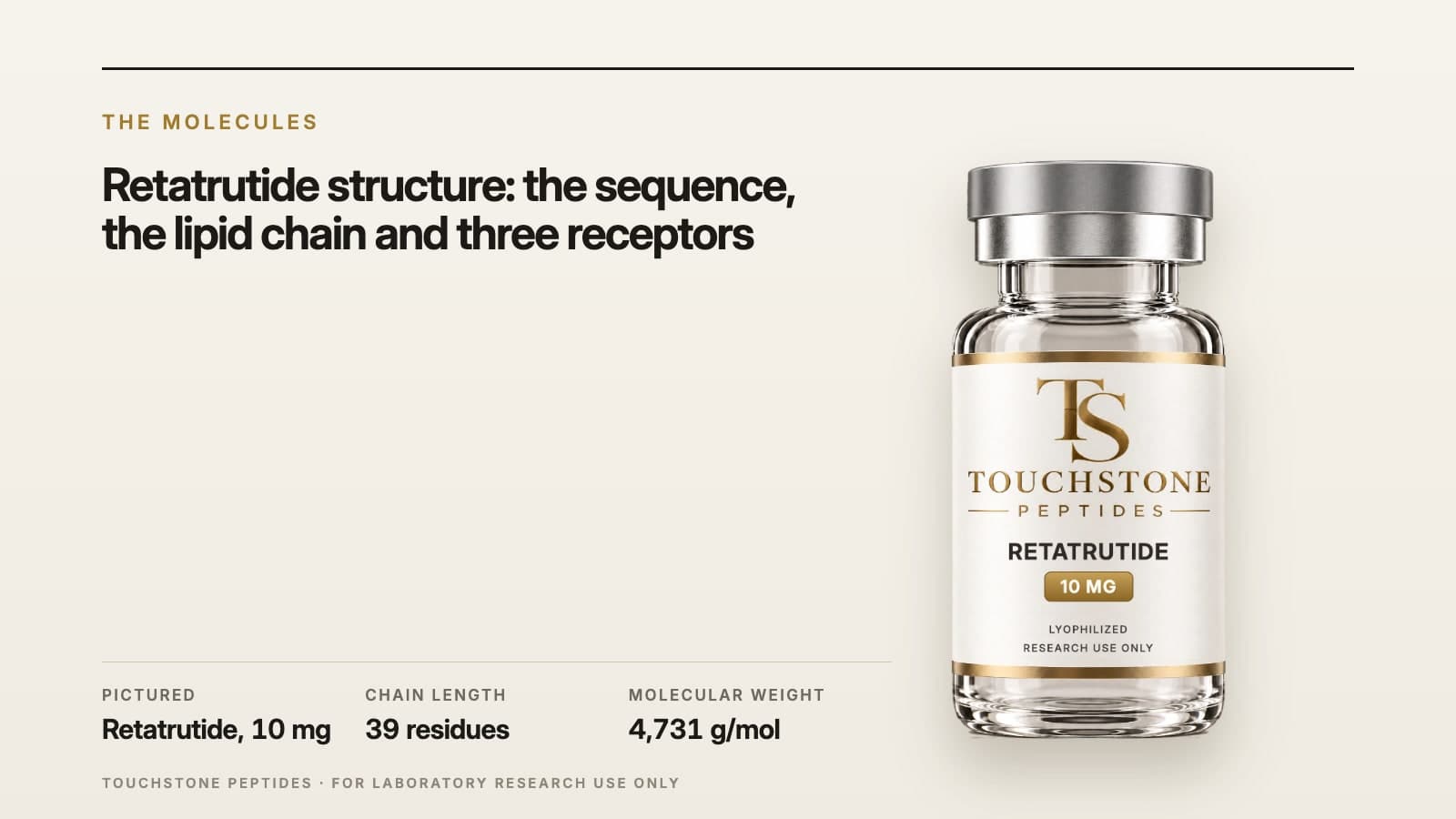
Retatrutide (LY3437943) is a synthetic peptide of 39 amino acids, built on the sequence of the hormone GIP and modified so that one molecule activates three receptors: the GIP receptor, the GLP-1 receptor and the glucagon receptor. Its structure carries two amino acids the genetic code does not encode, aminoisobutyric acid (Aib) and α-methyl-L-leucine, and a C20 fatty diacid attached through a linker to the lysine at position 17. PubChem gives the formula C221H342N46O68 and a molecular weight of 4,731. Cryo-EM structures of it bound to all three receptors were published in 2024, and they are the basis for most of what follows.
Retatrutide at a glance
Identifiers as recorded by PubChem and FDA's substance registry, re-read October 21, 2026.
| Property | Value | Source |
|---|---|---|
| Development code | LY3437943 | ClinicalTrials.gov |
| Length | 39 residues | FDA GSRS, UNII NOP2Y096GV |
| Backbone | Developed from the GIP sequence | Li et al., Cell Discovery, 2024 |
| Non-coded residues | Aib at 2 and 20, α-methyl-L-leucine at 13 | PDB 8YW3, 8YW4, 8YW5 |
| Lipidation | C20 fatty diacid through a γ-glutamate and ethoxy linker on lysine 17 | Position: Li et al., 2024. Chain and linker: PubChem systematic name |
| Formula | C221H342N46O68 | PubChem CID 171934787 |
| Molecular weight | 4,731 (average); monoisotopic 4,728.47 | PubChem CID 171934787 |
| FDA substance identifiers | UNII NOP2Y096GV (sodium salt LQ42M82ZU6); CAS 2381089-83-2 | FDA GSRS |
| Receptors | GIPR, GLP-1R, GCGR (agonist at all three) | Li et al., 2024; FDA GSRS |
| US status | No approval; investigational, as of October 21, 2026 | ClinicalTrials.gov; Drugs@FDA |
A research vial of retatrutide is this molecule as a lyophilized powder, labeled research use only. Where it stands with regulators, with dates, is in retatrutide's FDA status.
What is the retatrutide sequence?
FDA's Global Substance Registration System records retatrutide as a single chain of 39 residues. With the two non-coded amino acids written as the deposited receptor structures name them, the sequence is:
Y-Aib-Q-G-T-F-T-S-D-Y-S-I-αMeL-L-D-K-K-A-Q-Aib-A-F-I-E-Y-L-L-E-G-G-P-S-S-G-A-P-P-P-S
One letter stands for each standard amino acid, Aib for α-aminoisobutyric acid and αMeL for α-methyl-L-leucine. The lysine at 17 is the one that carries the lipid. The registry writes the chain in standard letters only (YAQGTFTSDYSILLDKKAQAAFIEYLLEGGPSSGAPPPS, with alanine at 2 and 20 and leucine at 13); the cryo-EM structures identify those three positions as Aib, Aib and αMeL. The structures contain residues 1 to 30 of the peptide at the GLP-1 and glucagon receptors and 1 to 27 at the GIP receptor.
The authors of the structural study describe retatrutide as "developed from the GIP" backbone, using segments the three hormones already share (residues 4 to 9, 11, 14, 15, 18, 22 and 25) to allow "simultaneous agonism at the three pivotal receptors."
What is retatrutide's molecular weight and formula?
PubChem's record CID 171934787 gives the formula C221H342N46O68, an average molecular weight of 4,731 and a monoisotopic mass of 4,728.47. The record is deposited as retatrutide sodium salt, but the formula and masses it lists are for the peptide without a counterion, which is the species a mass spectrometer measures.
The two figures serve different purposes. The average weight is what a balance and a content calculation use. The monoisotopic mass, the mass of the molecule built entirely from the most common isotopes, is what a high-resolution spectrum resolves. On a certificate, the identity line should report a mass consistent with one of these; how to read a retatrutide certificate covers what that means for the identity and purity lines.
Why two non-coded amino acids?
Aminoisobutyric acid at position 2 sits where the enzyme dipeptidyl peptidase-4 cuts native incretin hormones, two residues from the N-terminus. The same idea appears in the approved relatives: tirzepatide's label describes Aib at positions 2 and 13, and semaglutide's label describes a modification at its position 8 "to provide stabilization against degradation by the enzyme dipeptidyl-peptidase 4." Retatrutide places a second Aib at position 20 and uses α-methyl-L-leucine where tirzepatide has its second Aib, at 13.
These residues are also part of how the peptide binds. In the structures retatrutide forms a single continuous helix: residues 1 to 13 reach into the core of the receptor's transmembrane domain, and residues 14 to 30 lie along the extracellular domain and the top of the transmembrane helices. Among the contacts the three receptors share, the authors list hydrophobic interactions made through Tyr1, Gly4, Tyr10, αMeL13 and Aib2.
The lipid chain on lysine 17
Retatrutide, tirzepatide and semaglutide are each acylated: a fatty diacid is joined through a linker to one lysine. For retatrutide, PubChem's systematic name ends in "20-oxoicosanoic acid" joined through a γ-glutamate and an ethoxy spacer, which is a C20 diacid, the same chain length as tirzepatide's. The structural paper places the lysine at position 17 in retatrutide and at position 20 in tirzepatide and semaglutide, numbered along their own chains. Tirzepatide's label says its diacid "enables albumin binding and prolongs the half-life"; semaglutide's names albumin binding as its main protraction mechanism.
For anyone testing the material, the lipid matters in two ways. It makes the molecule markedly more hydrophobic than an unmodified peptide of the same length, which shapes how it behaves on a reversed-phase column, and it is part of the mass a spectrum has to match.
Retatrutide mechanism of action: what does "triple agonist" mean?
"Triple agonist" means a single molecule activates three different receptors. All three are class B1 G protein-coupled receptors that normally respond to related hormones: GIP, GLP-1 and glucagon. Retatrutide is not equally potent at all three. The structural paper summarises its developers' cell-assay data, citing Jastreboff et al. (NEJM, 2023):
Compared to the corresponding endogenous hormones, retatrutide is more potent at GIPR by a factor of 8.9, and less potent at GCGR and GLP-1R by factors of 0.3 and 0.4, respectively.Li et al., Cell Discovery, 2024
In plainer terms: about nine times as potent as GIP at the GIP receptor, and 0.4 and 0.3 times as potent as GLP-1 and glucagon at theirs. These are potencies in cells relative to each receptor's own hormone. They describe receptor activation, not anything about a person.
What do the cryo-EM structures show?
Three structures were released to the Protein Data Bank in 2024, each with retatrutide bound to a receptor coupled to its G protein:
| PDB entry | Receptor | Resolution | Released |
|---|---|---|---|
| 8YW3 | GLP-1 receptor | 2.68 Å | September 18, 2024 |
| 8YW4 | GIP receptor | 3.26 Å | September 18, 2024 |
| 8YW5 | Glucagon receptor | 2.84 Å | August 7, 2024 |
The authors tested which contacts matter by mutating the receptors and measuring the change in cAMP signalling. Replacing a conserved glutamate at position 6.53 with alanine reduced retatrutide's potency 3.6-fold at GLP-1R, 1.6-fold at GIPR and 8.3-fold at GCGR; a change at position 7.42 reduced it 71.6-fold at GIPR and 5.8-fold at GCGR. The same peptide relies on different contacts to different degrees in each receptor, which is how one sequence can be tuned toward one receptor more than another.
Retatrutide vs tirzepatide: how do the structures differ?
Both are 39-residue peptides developed from GIP, both open with tyrosine followed by Aib, and both carry a C20 diacid. Aligned position by position, 30 of the 39 residues are identical, and the whole final stretch from 29 to 39 (GGPSSGAPPPS) is shared. The nine differences:
| Position | Retatrutide | Tirzepatide |
|---|---|---|
| 3 | Gln (Q) | Glu (E) |
| 13 | α-methyl-L-leucine | Aib |
| 17 | Lys carrying the C20 diacid | Ile (I) |
| 20 | Aib | Lys carrying the C20 diacid |
| 23 | Ile (I) | Val (V) |
| 24 | Glu (E) | Gln (Q) |
| 25 | Tyr (Y) | Trp (W) |
| 27 | Leu (L) | Ile (I) |
| 28 | Glu (E) | Ala (A) |
The summary differences:
| Property | Retatrutide | Tirzepatide |
|---|---|---|
| Receptors | GIPR, GLP-1R, GCGR | GIPR, GLP-1R |
| Formula | C221H342N46O68 | C225H348N48O68 |
| Molecular weight | 4,731 | 4,813.53 |
| Lipidated lysine | 17 | 20 |
| Non-coded residues | Aib 2, αMeL 13, Aib 20 | Aib 2, Aib 13 |
| US status, October 21, 2026 | Investigational | Approved active ingredient |
A mass spectrum separates the two at once, because their molecular weights differ by 82. The tirzepatide structure and sequence piece covers the other molecule in the same depth, and the semaglutide vs tirzepatide vs retatrutide comparison adds semaglutide, a 31-residue GLP-1 analogue with a C18 diacid. The retatrutide research reference gathers identity, status and every certificate on file.
Frequently asked questions
What is the structure of retatrutide?
A single chain of 39 amino acids developed from GIP, with Aib at positions 2 and 20, α-methyl-L-leucine at 13 and a C20 fatty diacid attached through a γ-glutamate and ethoxy linker to lysine 17. Bound to its receptors it forms one continuous helix.
What is the retatrutide sequence?
Y-Aib-Q-G-T-F-T-S-D-Y-S-I-αMeL-L-D-K-K-A-Q-Aib-A-F-I-E-Y-L-L-E-G-G-P-S-S-G-A-P-P-P-S, with the lipid on the lysine at 17. FDA's registry writes it in standard letters as YAQGTFTSDYSILLDKKAQAAFIEYLLEGGPSSGAPPPS.
What is retatrutide's molecular weight?
4,731 average, with a monoisotopic mass of 4,728.47, for the formula C221H342N46O68 (PubChem CID 171934787).
What does "triple agonist" mean?
One molecule activates three receptors. Retatrutide is an agonist at the GIP, GLP-1 and glucagon receptors; tirzepatide is an agonist at two of them and semaglutide at one.
At which receptor is retatrutide most potent?
In cell-assay data summarised in the 2024 structural paper, retatrutide is 8.9 times as potent as native GIP at the GIP receptor, and 0.4 and 0.3 times as potent as native GLP-1 and glucagon at their receptors.
Does retatrutide have a CAS number?
FDA's Global Substance Registration System lists CAS 2381089-83-2, with UNII NOP2Y096GV, and a separate record, UNII LQ42M82ZU6, for retatrutide sodium.
Sources
- Li W, Zhou Q, Cong Z et al., Structural insights into the triple agonism at GLP-1R, GIPR and GCGR manifested by retatrutide, Cell Discovery 10:77, 2024 (PubMed 39019866)
- PDB 8YW3, retatrutide bound to the GLP-1 receptor, RCSB Protein Data Bank
- PDB 8YW4, retatrutide bound to the GIP receptor, RCSB Protein Data Bank
- PDB 8YW5, retatrutide bound to the glucagon receptor, RCSB Protein Data Bank
- Retatrutide (sodium salt), PubChem CID 171934787, National Library of Medicine, read October 21, 2026
- Retatrutide, UNII NOP2Y096GV, FDA Global Substance Registration System
- Tirzepatide prescribing information, sections 11 and 12.1, DailyMed
- Semaglutide prescribing information, sections 11 and 12.1, DailyMed
- Drugs@FDA records with retatrutide as an active ingredient, openFDA API, queried 2026-10-21 (no matches)
- Studies with retatrutide as an intervention, ClinicalTrials.gov API v2, queried 2026-10-21
For laboratory research use only. Not a drug, not a supplement, and nothing here is a claim about what any of this material does in a person or an animal.