
Tirzepatide structure and sequence
Tirzepatide is a 39-residue peptide built on GIP, with aminoisobutyric acid at positions 2 and 13, a C20 fatty diacid on lysine 20 and an amidated end. The sequence, each modification and the 2022 receptor structures.
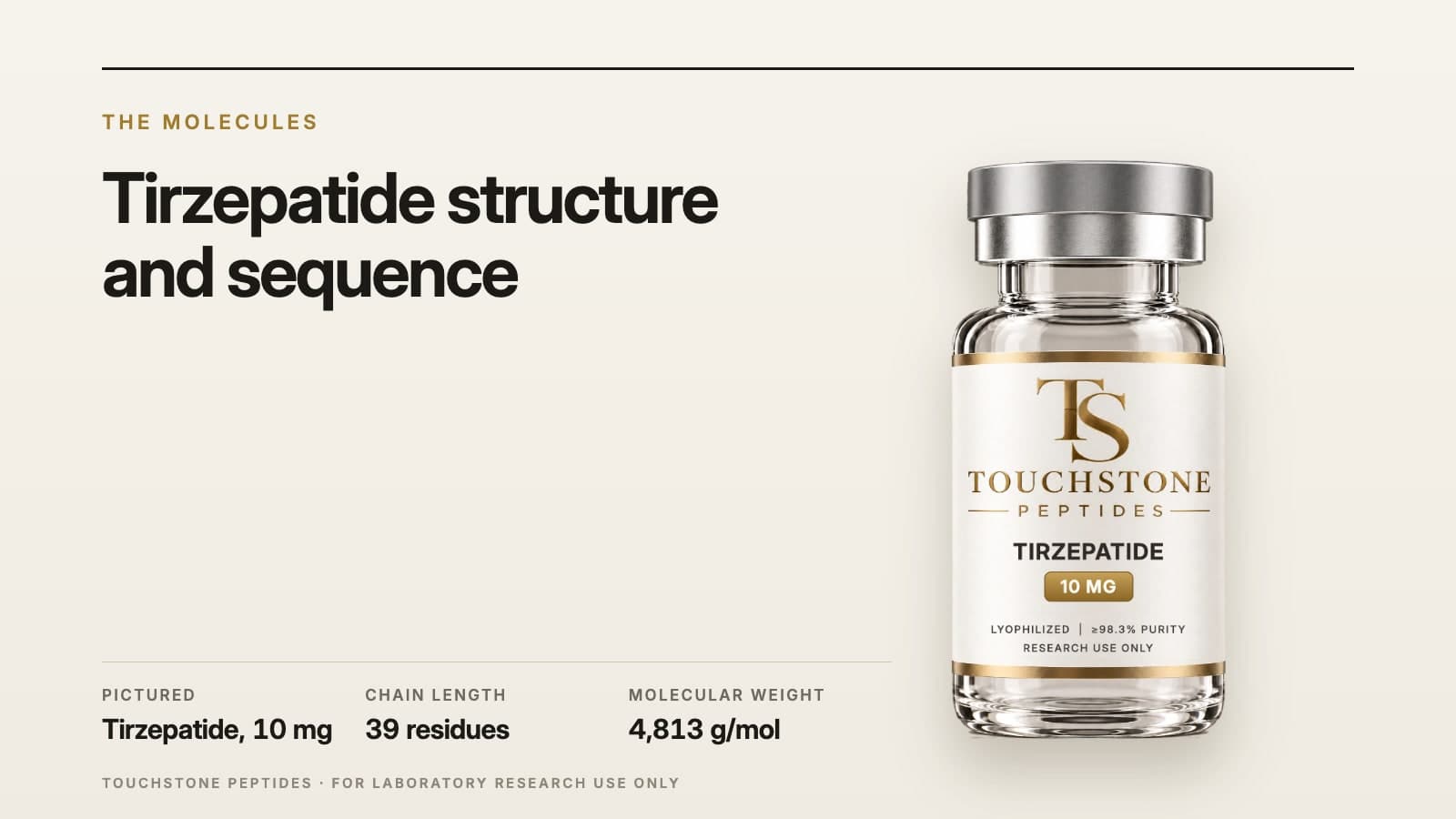
Tirzepatide is a single chain of 39 amino acids, "based on the GIP sequence" in its label's words, GIP being the hormone glucose-dependent insulinotropic polypeptide. Three kinds of change set it apart from a natural peptide: aminoisobutyric acid (Aib) at positions 2 and 13, a C20 fatty diacid attached to lysine 20 through a linker, and an amide in place of the free acid at the end of the chain. Its formula is C225H348N48O68 and its molecular weight 4,813.53, as stated on its FDA label.
What is the tirzepatide sequence?
Written with the modifications in place, from FDA's Global Substance Registration System and section 11 of the Mounjaro label:
Y-Aib-E-G-T-F-T-S-D-Y-S-I-Aib-L-D-K-I-A-Q-K(lipid)-A-F-V-Q-W-L-I-A-G-G-P-S-S-G-A-P-P-P-S-NH2
Two cautions when comparing this with other listings. FDA's registry gives a plain one-letter string, YAEGTFTSDYSIGLDKIAQKAFVQWLIAGGPSSGAPPPS, in which positions 2 and 13 show A and G; those letters are placeholders, and the registry's own modification table replaces both with Aib. And "K" at position 20 stands for a lysine that carries the whole lipid side chain, not a plain lysine. The tirzepatide research reference draws the sequence residue by residue with these positions marked. How to read a peptide sequence explains the notation.
What does each modification do?
| Position | Change | What the label or the registry states |
|---|---|---|
| 2 | Aminoisobutyric acid | Label: "contains aminoisobutyric acid (Aib) in positions 2 and 13" |
| 13 | Aminoisobutyric acid | Same sentence of the label; the registry lists "2-Aminoisobutyric acid" at both sites |
| 20 | Lysine carrying a C20 fatty diacid | Label: "a Lys residue at position 20 that is attached to 1,20-eicosanedioic acid via a linker" |
| 39 | C-terminal amide | Label: "a C-terminal amide"; the registry names the last residue serinamide |
The label states the albumin role in one line: tirzepatide "contains a C20 fatty diacid that enables albumin binding." The label describes the attachment only as "via a linker"; FDA's substance registry names it as a γ-glutamic acid followed by two 8-amino-3,6-dioxaoctanoic acid spacers, short ethylene-glycol links, between the lysine and the diacid.
Why is a GIP-based peptide active at the GLP-1 receptor?
It was introduced as a dual agonist. The 2018 Molecular Metabolism paper that introduced it described LY3298176 as "a fatty acid modified peptide with dual GIP and GLP-1 receptor agonist activity," and the label puts it as "a GIP receptor and GLP-1 receptor agonist" that "selectively binds to and activates both the GIP and GLP-1 receptors, the targets for native GIP and GLP-1." The published structures below show the one chain bound in each receptor.
What do the receptor structures show?
Two groups published cryo-electron microscopy structures of tirzepatide bound to each receptor in 2022, both deposited in the Protein Data Bank.
| PDB entry | What it shows | Paper |
|---|---|---|
| 7FIY | Tirzepatide bound to the human GIP receptor with Gs | Zhao et al., Nature Communications, 2022 |
| 7FIM | Tirzepatide bound to the human GLP-1 receptor with Gs | Zhao et al., Nature Communications, 2022 |
| 7VAB, 7VBI | The same two receptors with tirzepatide lacking its lipid | Zhao et al., Nature Communications, 2022 |
| 7RBT | Tirzepatide bound to the human GIP receptor | Sun et al., PNAS, 2022 |
| 7RGP | Tirzepatide bound to the human GLP-1 receptor | Sun et al., PNAS, 2022 |
The Shanghai paper set out to "determine cryo-electron microscopy structures of tirzepatide-bound GIPR and GLP-1R"; the Lilly paper is titled "Structural determinants of dual incretin receptor agonism by tirzepatide." The non-lipidated structures let the two be compared with and without the fatty acid chain in place.
How does it compare with retatrutide and semaglutide?
Tirzepatide and retatrutide are both 39-residue peptides built on GIP and both open with tyrosine followed by Aib. Retatrutide puts its lipid on lysine 17 rather than 20, carries α-methyl-L-leucine at 13 and a second Aib at 20, and reaches the glucagon receptor as well. Semaglutide is a 31-residue GLP-1 analogue with a C18 diacid. The molecules are tabled side by side in tirzepatide vs semaglutide and in the three-way comparison with retatrutide.
Where does the 4,813.53 come from?
From the formula C225H348N48O68 at average atomic weights, as printed in section 11 of both labels. PubChem gives the monoisotopic mass as 4,810.52, which is the figure that matters on a high-resolution mass spectrum, and rounds the average weight to 4,813. PubChem holds more than one record with this formula (CID 166567236 is another); the one titled tirzepatide is CID 156588324. What a laboratory should see on a spectrum is set out in how to read a tirzepatide certificate.
Common questions
How many amino acids are in tirzepatide?
Thirty-nine, numbered from the N-terminal tyrosine to the C-terminal serinamide, as recorded in FDA's Global Substance Registration System.
Where is the fatty acid attached in tirzepatide?
On the side chain of lysine 20, through a γ-glutamic acid and two short ethylene-glycol spacers, ending in 1,20-eicosanedioic acid, a C20 fatty diacid.
Which positions in tirzepatide are not standard amino acids?
Positions 2 and 13 are aminoisobutyric acid (Aib), an amino acid the genetic code does not encode, as the label states. Lysine 20 carries the lipid side chain, and the chain ends in an amide.
Is tirzepatide a peptide or a small molecule?
A peptide: a chain of 39 amino acids with a lipid side chain, at a molecular weight of 4,813.53, far beyond the size of a small-molecule drug.
Sources
- MOUNJARO (tirzepatide) prescribing information, sections 11 and 12.1, revised 8/2026, DailyMed
- Tirzepatide, UNII OYN3CCI6QE, FDA Global Substance Registration System, edited August 10, 2026
- Tirzepatide, PubChem CID 156588324, National Library of Medicine
- Coskun T et al., LY3298176, a novel dual GIP and GLP-1 receptor agonist, Molecular Metabolism, 2018
- Zhao F et al., cryo-EM structures of tirzepatide-bound GIPR and GLP-1R, Nature Communications, 2022
- Sun B et al., Structural determinants of dual incretin receptor agonism by tirzepatide, PNAS, 2022
- PDB 7FIY, tirzepatide-bound human GIPR-Gs complex, RCSB
- PDB 7FIM, tirzepatide-bound human GLP-1R-Gs complex, RCSB
- PDB 7RBT, GIPR bound to tirzepatide, RCSB
- PDB 7RGP, GLP-1R bound to tirzepatide, RCSB
For laboratory research use only. Not a drug, not a supplement, and nothing here is a claim about what any of this material does in a person or an animal.