
What "research use only" means for peptides, and whether it is legal
What a research use only label means, what it does not do, how FDA decides whether a research peptide is really a drug, and the line this site draws because of it. Status as of October 21, 2026.
"Research use only" (RUO) means a material is supplied for laboratory research, such as work in glassware, on cells or as an analytical reference, and not for use in people or animals. For peptides it is a statement of intended use, not a licence or an exemption: FDA decides what a product is for from what the seller says and does, and a label does not override that. Status as of October 21, 2026 the only FDA regulation that sets out "For Research Use Only" labeling, 21 CFR 809.10(c), applies to in vitro diagnostic products, not to peptides.
What does research use only mean?
The phrase describes who a material is for and what it is for. A research-use-only peptide is sold as a reagent: a synthetic chain of amino acids, usually a lyophilized powder, supplied so that a laboratory can study it, measure it or use it as a standard. It is not a drug. It has not been approved by any regulator for any condition, and it is not manufactured, filled or released to the standards an approved medicine has to meet.
Three things follow from that definition:
- It is a description of intended use. The words tell the buyer, and any regulator reading the page, what the seller intends the product to be used for.
- It is not a quality grade. RUO says nothing about purity, identity or content. Those are answered by testing, lot by lot, and shown on a certificate.
- It is not an approval of any kind. No agency registers, reviews or grants "research use only" status for a peptide.
What does RUO mean for peptides specifically?
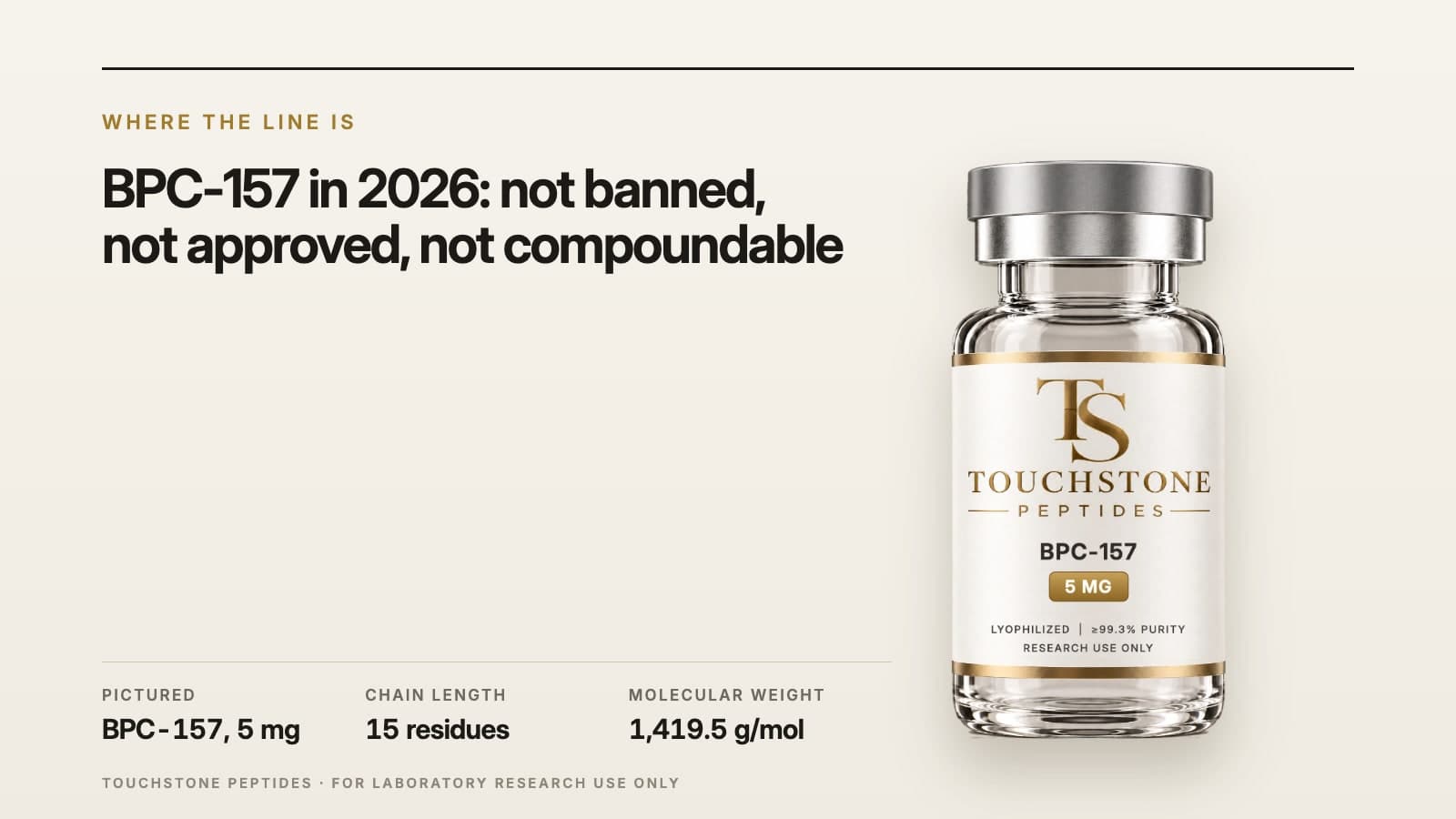
Most peptides sold as research reagents are not approved drugs, and some are close relatives of molecules that are. BPC-157, a fifteen-residue peptide we stock as a lyophilized vial, is an example of the first kind: it is not an FDA-approved drug, and WADA's 2026 Prohibited List names it as a substance "with no current approval by any governmental regulatory health authority for human therapeutic use." Other research peptides share an active ingredient with an approved medicine. The table of FDA-approved peptides sets out which is which, with dates.
In both cases the RUO label means the same thing: the vial is a research material, not the approved product and not a substitute for it. An approved medicine is defined by its application, its manufacturing controls and its label, not only by its molecule.
Is research use only legal?
Selling a chemical for genuine laboratory research is a lawful activity, and research reagents are bought and sold every day. Whether a particular RUO peptide is lawfully sold turns on one question: what is it really intended for? FDA does not answer that from the disclaimer. Its regulation on intended use says:
The intent may be shown by such persons' expressions, the design or composition of the article, or by the circumstances surrounding the distribution of the article. This objective intent may, for example, be shown by labeling claims, advertising matter, or oral or written statements by such persons or their representatives.21 CFR 201.128, Meaning of "intended uses"
If the objective intent is use in people, the product meets the federal definition of a drug, which includes:
articles intended for use in the diagnosis, cure, mitigation, treatment, or prevention of disease in man or other animals; and (C) articles (other than food) intended to affect the structure or any function of the body of man or other animals21 U.S.C. 321(g)(1)
A drug that is not generally recognized as safe and effective is a "new drug" (21 U.S.C. 321(p)), and a new drug may not be introduced into interstate commerce without an approved application (21 U.S.C. 355(a)); doing so is a prohibited act under 21 U.S.C. 331(d). Those four sections are the ones FDA cites in its letters to research-peptide sellers.
So the short answer: a research use only label is legal to use, and selling peptides as research reagents is lawful when the selling is consistent with that label. The label does not make a product lawful if everything around it says the product is meant for people.
How does FDA decide whether a research peptide is really a drug?
FDA's warning letters to research-peptide sellers from December 2024 to August 2026, and its letters to sellers of other "research chemicals", follow one formula. Each opens by setting the label aside:
Despite statements on your product labeling marketing your products 'for research use only' and 'not for human or animal consumption,' evidence obtained from your website establishes that your products are intended to be drugs for human use.FDA warning letter to Royal Peptides LLC, August 24, 2026
The evidence those letters cite falls into a few repeated categories:
- therapeutic or physiological claims on product pages, including outcome figures from clinical trials
- solvents sold alongside peptides that need dissolving before use, which FDA reads as evidence of intended use in people
- delivery supplies sold on the same site
- guides and calculators for preparing the product
- customer reviews describing effects
FDA put the solvent point plainly in one letter:
In addition to the cited drug claims, you market bacteriostatic water alongside a 'peptide guide' and 'peptide calculator,' resources that collectively provide the means to prepare an injectable drug for human administration.FDA warning letter to Royal Peptides LLC, August 24, 2026
None of these letters turns on the chemistry of the peptide. They turn on what the seller said and sold around it. What FDA reads before calling a research product a drug goes through the letters one by one.
Is RUO the same as FDA approval, compounding or diagnostic RUO?
No. The phrase sits beside several other categories that are easy to confuse.
| Category | What it is | Who oversees it | Can it be sold for use in people? |
|---|---|---|---|
| Research use only peptide | A reagent sold for laboratory research | No product-specific review; intended use judged under 21 CFR 201.128 | No |
| FDA-approved drug | A medicine with an approved application and label | FDA, under 21 U.S.C. 355 | Yes, as labeled |
| Compounded drug (503A or 503B) | A drug prepared by a pharmacy or outsourcing facility under statutory conditions | FDA and state boards of pharmacy | Only within those conditions |
| RUO in vitro diagnostic | A diagnostic product in the laboratory research phase | FDA, under 21 CFR 809.10(c) | No, and not for diagnostic procedures |
The last row is the only place "For Research Use Only" appears as a labeling rule in FDA regulations, and it covers diagnostic products. It is not an exemption for research chemicals or peptides. How the compounding categories work is set out in 503A, 503B and research use only.
What research use only means on this site
If the label is to mean anything, the site around it has to be consistent with it. That decides the shape of everything here.
- No amounts, preparation steps or use information, for people or for animals, anywhere on the site.
- No claims about effects in a body, including implied ones, and no customer stories that make them.
- No comparison photographs and no suggested regimens.
- Reviews, where published, are about the supplier: what arrived, how it was packed, whether the paperwork matched the vial.
If a supplier cannot say what a compound does, what is left to compete on is what is verifiably in the vial. That is why we name the upstream manufacturer, send a second sample from each lot to an independent laboratory, publish purity and net peptide content, and keep the reports in a public certificate library where each one can be checked against the laboratory's own copy. What we will not sell, and why, is listed under our limits.
Frequently asked questions
What does research use only mean?
It means a material is supplied for laboratory research, such as in vitro work or use as an analytical standard, and not for use in people or animals. It describes intended use; it is not an approval or a quality grade.
Is research use only legal?
Selling peptides as research reagents is lawful when the selling is consistent with the label. Under 21 CFR 201.128 FDA judges intended use from claims, advertising and the circumstances of sale, so an RUO label does not make lawful a product that is marketed for use in people.
Are research use only peptides FDA approved?
No. RUO is not an FDA status, and no agency approves a peptide as "research use only." Some research peptides share an active ingredient with an approved medicine, but the research vial is not that medicine.
Does an RUO label protect a seller from FDA?
Not on its own. FDA's warning letters to research-peptide sellers state that, despite "research use only" labeling, evidence from the sellers' websites showed the products were intended as drugs for human use.
Is "not for human consumption" the same as research use only?
They make the same point in different words, and FDA reads them the same way. Its letters quote both phrases and set them aside when the rest of the site points to use in people.
What does RUO mean on a certificate of analysis?
It restates the intended use of the lot the certificate describes. The certificate itself answers the separate questions of identity, purity and content.
Sources
- 21 CFR 201.128, Meaning of "intended uses", govinfo, 2024 edition
- 21 CFR 809.10, Labeling for in vitro diagnostic products, govinfo, 2024 edition
- 21 U.S.C. 321, Definitions, Office of the Law Revision Counsel
- 21 U.S.C. 331, Prohibited acts, Office of the Law Revision Counsel
- 21 U.S.C. 355, New drugs, Office of the Law Revision Counsel
- Warning letter to Royal Peptides LLC, FDA, August 24, 2026
- Warning letter to Gram Peptides, FDA, March 31, 2026
- Warning letter to USApeptide.com, FDA, February 26, 2025
- Warning letter to PureRawz, FDA, September 8, 2025
- The 2026 Prohibited List, World Anti-Doping Agency, effective January 1, 2026
For laboratory research use only. Not a drug, not a supplement, and nothing here is a claim about what any of this material does in a person or an animal.