
Home Blog Reading the paperwork
How to read a retatrutide certificate of analysis
Identity, purity, measured content, endotoxin, metals, sterility and the issue history: what each line on a retatrutide certificate measures, worked through on real laboratory certificates.
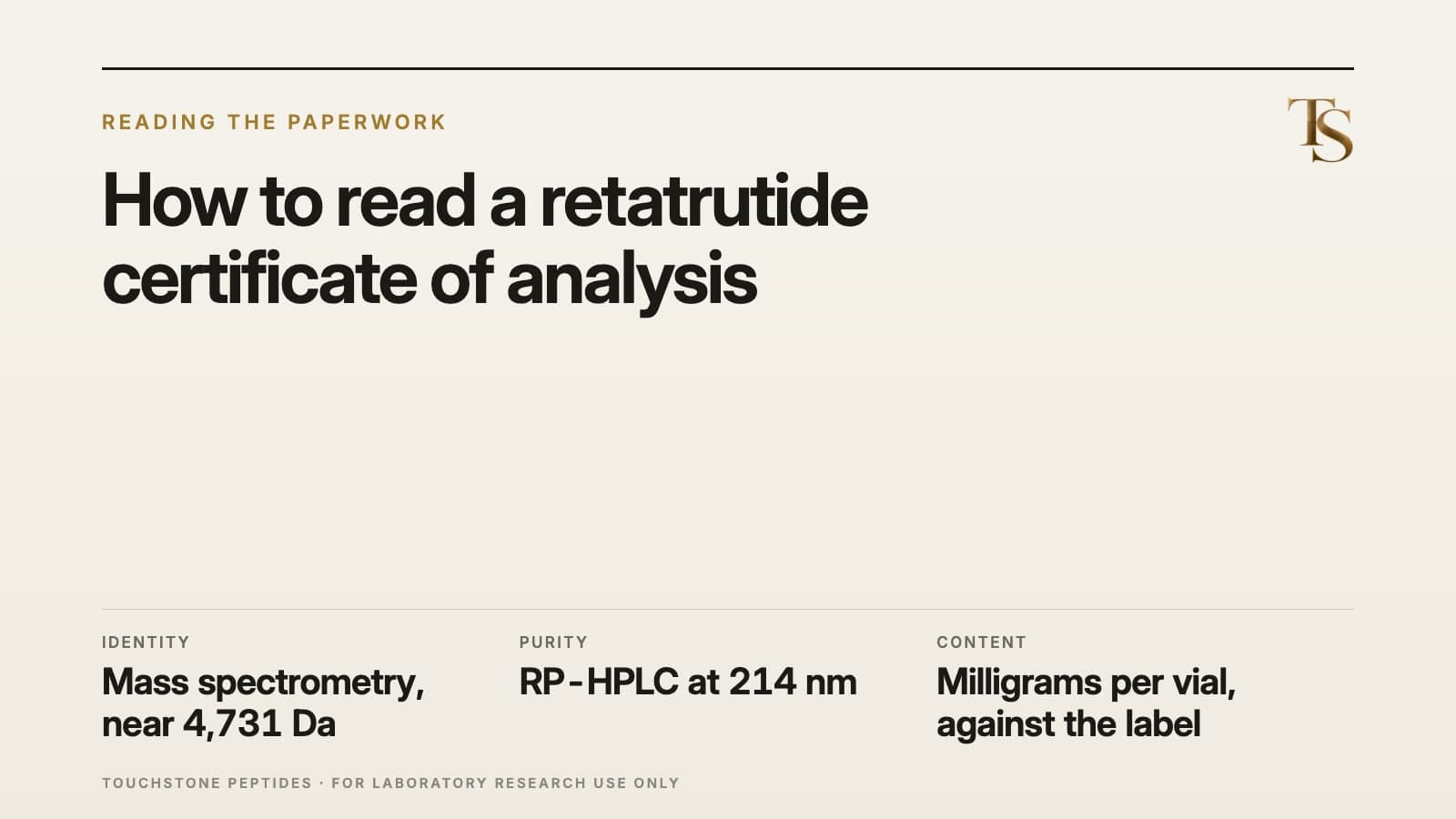
A retatrutide certificate of analysis answers four questions about one lot: is the material retatrutide, how much of what the detector sees is the main peptide, how much retatrutide is in the vial, and what else the laboratory screened for. Identity is a mass spectrometry line, purity is a reversed-phase HPLC figure, content is a quantitation in milligrams, and endotoxin, elemental impurities and sterility follow. Each line is only as useful as its method, its units and its match to the lot number on the vial, so this piece reads every line in that order, using the retatrutide certificates on file as worked examples.
What is on a retatrutide certificate?
The certificates for this compound come from one testing laboratory, Bioviridian Inc., on samples submitted by the supplier each certificate names, and they share a layout. One current certificate, COA7599 for lot RETA20-0803, reads like this:
| Line on the certificate | What it measures | What COA7599 states |
|---|---|---|
| Identity | Whether the molecular mass matches retatrutide | LC-MS/MS, conforms |
| Purity | Share of the UV-absorbing material that is the main peak | 99.79%, RP-HPLC at 214 nm |
| Content | Milligrams of retatrutide in the vial | 20.22 mg, HPLC quantitation, against a 20 mg label |
| Endotoxin | Bacterial endotoxin in the test solution | Below 0.05 EU/mL, USP <85> |
| Heavy metals | Elemental impurities | Below 0.01 ppm, citing USP <232> |
| Sterility | Microbial growth in the tested sample | Not detected, USP <71> |
| Dates | When the sample arrived and the certificate was issued | Received August 11, 2026; issued August 28, 2026 |
Every certificate figure below is as the laboratory's copies stood when last checked, on September 24, 2026; the PubChem figures are as of October 13, 2026. Before any figure, match three things: the lot number printed on the vial, the lot number on the certificate, and the certificate number on the laboratory's own site. A certificate for the right compound and the wrong lot describes a different batch.
Identity: does the mass match retatrutide?
Identity on these certificates is established by mass spectrometry. PubChem's record gives the formula C221H342N46O68, a molecular weight of 4,731 and a monoisotopic mass of 4,728.47; the formula's average mass is about 4,731.4. A peptide this size is usually seen in electrospray instruments as a set of multiply charged ions rather than one peak, so the numbers on a spectrum sit near the mass divided by the charge:
| Charge state | Approximate m/z (average mass) |
|---|---|
| [M+3H]3+ | about 1,578.1 |
| [M+4H]4+ | about 1,183.9 |
| [M+5H]5+ | about 947.3 |
Those values are arithmetic on the formula's average mass, shown so a reader can recognise the pattern. Mass separates retatrutide cleanly from its closest catalogue relatives, set side by side on the semaglutide, tirzepatide and retatrutide comparison: tirzepatide is 4,813 and semaglutide 4,114, so neither can pass as the other on a working instrument. What mass alone cannot do is tell two sequences with the same composition apart, which is why it is paired with the chromatography below. How the method works, and what a match within a given tolerance does and does not prove, is set out in how mass spectrometry confirms a peptide's identity.
Two things are worth knowing about the certificates on file. The May and June 2026 lots were tested by MALDI-MS and the August 2026 lots by LC-MS/MS, so the method changed between batches and each certificate names its own. And all of them report identity as "Conforms" without printing the observed mass. A conformance statement is the laboratory's conclusion; the observed mass is the evidence behind it, and it is a fair thing to ask the laboratory for.
Purity: what 99.79% by RP-HPLC means
The purity figure is the area of the main peak as a share of all the peaks the detector records, here by reversed-phase HPLC with detection at 214 nm, where the peptide bond absorbs. On the current certificates it runs from 99.79% to 99.9%.
Three limits apply to any figure like this. It counts only what absorbs at that wavelength, so counter-ion and water are largely invisible to it. It is relative, not absolute: a vial can be very pure and still hold less peptide than its label, which is why content is a separate line. And it depends on the method, so two laboratories running different gradients can disagree by a few tenths of a percent on the same material; which differences are normal is a question of method validation, the subject of the ICH Q2 guideline listed below. The certificates on file also print the figure to different precision, one decimal place on the June lot still current and two on the August lots. More decimals is a reporting choice, not a more accurate measurement.
Content: how much retatrutide is in the vial?
Content is the line most buyers skip and the one that answers the question on the label. These certificates report it as milligrams of retatrutide measured by HPLC quantitation, a method that typically compares the sample's peak against a reference standard of known amount.
| Lot | Label | Measured content | Share of label |
|---|---|---|---|
| RETA20-0803 | 20 mg | 20.22 mg | 101.1% |
| RETA30-0803 | 30 mg | 30.94 mg | 103.1% |
| RETA48-0616 | 48 mg | 48.16 mg | 100.3% |
| RETA60-0803 | 60 mg | 61.26 mg | 102.1% |
A measured figure slightly above the label can come from the fill itself and from the uncertainty every quantitation carries. A figure well below it is the one to question. This is a different measurement from net peptide content, which is the peptide's share of the powder's total weight; these certificates report milligrams per vial rather than that percentage. The distinction is set out in net peptide content.
Endotoxin, heavy metals and sterility
Endotoxin is reported as below 0.05 EU/mL by USP <85>, the bacterial endotoxins test. The unit is per millilitre of the solution the laboratory tested, so the figure can only be compared between certificates when the concentration tested is known; converting it to EU per milligram needs that concentration, which these certificates do not print.
Heavy metals are reported as below 0.01 ppm, citing USP <232>. That chapter sets the limits for elemental impurities; the measuring procedures are in its companion chapter, USP <233>. A certificate that names the limits chapter is telling you which standard the reading is judged against, not how it was measured.
Sterility is reported as not detected under USP <71>, the compendial sterility test. It describes the units the laboratory tested on the day it tested them.
Dates, reissues and the laboratory's own copy
Every certificate carries two dates: when the laboratory received the sample and when it issued the report. For lot RETA20-0803 those are August 11 and August 28, 2026. A certificate issued long before the lot it is shown against is a reason to check the lot number again.
Laboratories reissue certificates, and the history matters. COA7599 exists in two copies under the same number: an earlier one dated August 17, 2026, published by the supplier, and the laboratory's current issue of August 28. Compared with the earlier copy, the current issue adds the sterility line, and it changes the sample description from "Blue lyophilized powder" to "White lyophilized powder." Each certificate page on this site lists every issue with its date and a fingerprint of the file, so a change can be seen rather than discovered. The last step is always the laboratory's own copy: enter the certificate number on the laboratory's verification page and compare lot, dates and figures with what you were given. How to verify a peptide lab report covers that check and what to do when the copies differ.
Reading a retatrutide and cagrilintide blend certificate
The blend's certificate, COA7594 for lot RTCAG15-0803, shows why a two-component vial needs more than one number. The sample is named "Reta/ Cagri 15mg," the total of the two components (the catalogue lists the blend by its 12.5 mg of retatrutide), while the content line gives two separate figures, 12.59 mg and 2.61 mg. The certificate does not say which figure belongs to which peptide; the sizes suggest the first is retatrutide, but that is an inference, not a line on the certificate. The purity line is a single figure for the vial, 99.70%. A single purity figure for two peptides says the chromatogram as a whole was clean; it does not say how pure each component was on its own. What a blend certificate should say sets out what a complete one carries.
A checklist for any retatrutide certificate
- The lot number on the certificate matches the vial.
- The certificate number opens the same document on the laboratory's site.
- Identity names a mass spectrometry method; ideally the observed mass is printed and sits near 4,731.
- Purity names the method and the wavelength.
- Content is stated in milligrams and is close to the label.
- Endotoxin, metals and sterility name their standards, and units are stated.
- The issue date makes sense for the lot, and any reissue is explained.
A certificate establishes what was in the tested sample. It says nothing about regulatory status, which for retatrutide is set out in is retatrutide FDA approved?
Common questions
What should a retatrutide certificate of analysis include?
At minimum: identity by mass spectrometry, purity by RP-HPLC with the wavelength, content in milligrams, and the lot number, sample receipt date and issue date. The certificates on file here also report endotoxin, elemental impurities and sterility. A certificate that gives only a purity percentage cannot show the material is retatrutide or how much of it the vial holds.
What molecular weight should retatrutide show on mass spectrometry?
PubChem gives a molecular weight of 4,731 and a monoisotopic mass of 4,728.47 for the formula C221H342N46O68. In electrospray instruments the peptide usually appears as multiply charged ions, for example near m/z 1,183.9 for the 4+ ion and 947.3 for the 5+ ion, which are approximate values from the average mass.
Does a high purity figure mean the vial holds the labelled amount?
No. Purity by RP-HPLC is a share of the peaks the detector sees; it says nothing about how much peptide is in the vial. That is the content line, which on these certificates is a measured quantity in milligrams compared with the label.
Why is the measured content above the label on some certificates?
The fill itself can sit slightly above the labelled amount, and every quantitation carries some uncertainty. The current certificates read about 100 to 103 percent of the label; a figure well below the label is the one that needs an explanation.
How can I tell whether a retatrutide certificate is genuine?
Enter the certificate number on the testing laboratory's own verification page and compare the lot number, dates and figures with the copy you were given. Then check that the lot on the certificate matches the lot printed on the vial. A certificate the laboratory cannot produce under its own number should not be relied on.
Sources
- Retatrutide (sodium salt), PubChem CID 171934787, National Library of Medicine, read October 13, 2026
- Retatrutide, UNII NOP2Y096GV, FDA Global Substance Registration System
- Li W et al., Structural insights into the triple agonism at GLP-1R, GIPR and GCGR manifested by retatrutide, Cell Discovery, 2024
- MOUNJARO (tirzepatide) prescribing information, section 11 Description, DailyMed
- OZEMPIC (semaglutide) prescribing information, section 11 Description, DailyMed
- ICH Q2(R2), Validation of analytical procedures, International Council for Harmonisation, 2023
- Certificate verification, Bioviridian Inc.
For laboratory research use only. Not a drug, not a supplement, and nothing here is a claim about what any of this material does in a person or an animal.