

Home Research library Retatrutide
Research reference · updated October 13, 2026
What is retatrutide? A research reference
Retatrutide, development code LY3437943, is an investigational peptide from Eli Lilly and Company that activates three receptors at once: the GIP receptor, the GLP-1 receptor and the glucagon receptor. It is a 39-residue synthetic peptide built on the GIP sequence, with a fatty diacid on one lysine. It is not approved by the FDA; Lilly has said it plans to submit an application in the first quarter of 2027. This page is the reference sheet, and each question has its own page below.
At a glance
| Name | Retatrutide |
|---|---|
| Development code | LY3437943 |
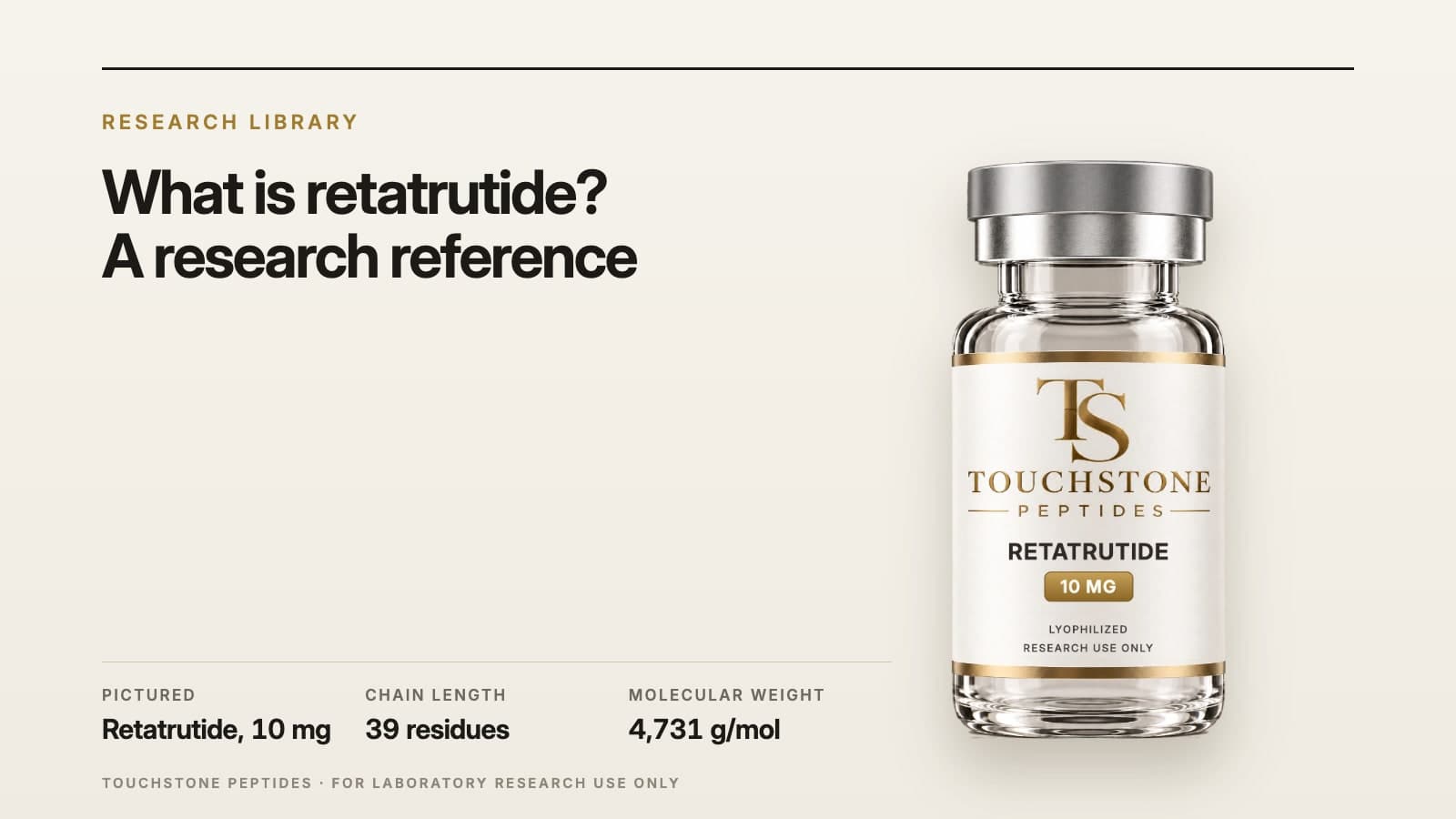
| Chain length | 39 residues |
| Molecular formula | C221H342N46O68 |
| Molecular weight | 4,731 g/mol |
| PubChem record | CID 171934787 |
| Status | Investigational. No FDA-approved product; Lilly plans to submit a Biologics License Application in the first quarter of 2027. Checked October 13, 2026. |
| Identifier | Value | Source |
|---|---|---|
| INN | retatrutide (WHO INN 12350) | FDA GSRS |
| FDA UNII | NOP2Y096GV; sodium salt LQ42M82ZU6 | FDA GSRS |
| CAS number | 2381089-83-2 | FDA GSRS |
| Monoisotopic mass | 4,728.47 | PubChem |
| Receptor structures | PDB 8YW3 (GLP-1R), 8YW4 (GIPR), 8YW5 (GCGR) | RCSB Protein Data Bank |
Formula and weight are PubChem’s; the registry identifiers are FDA’s. The status line is dated and is rechecked on every filing, approval or FDA action.
What retatrutide is
Retatrutide is a single synthetic peptide that is an agonist at three related receptors. Lilly's publications describe it in the same terms throughout its development: the 2022 Lancet paper calls it "a single peptide with agonist activity for glucagon, glucose-dependent insulinotropic polypeptide (GIP), and glucagon-like peptide 1 (GLP-1) receptors." Semaglutide acts at one of those receptors and tirzepatide at two.
Its name is an International Nonproprietary Name, and it is registered with FDA's Global Substance Registration System as UNII NOP2Y096GV. PubChem's record CID 171934787, deposited as retatrutide sodium salt, gives the formula C221H342N46O68.
How it is built
- A GIP-based chain of 39 residues, as recorded in FDA's substance registry. It shares its first two residues with tirzepatide.
- Two amino acids the genetic code does not encode: aminoisobutyric acid at positions 2 and 20 and α-methyl-L-leucine at 13.
- A C20 fatty diacid on lysine 17, joined through a linker, as in tirzepatide and semaglutide.
Its structure bound to each of the three receptors was published in 2024. The sequence, the role of each modification and what those structures show are in retatrutide structure and receptors.
Where it stands
Retatrutide is an investigational new drug. It is being studied in Lilly's Phase 3 program under an investigational new drug application, no retatrutide product appears in Drugs@FDA, and Lilly says it plans to submit a Biologics License Application to the FDA in the first quarter of 2027, a plan first given on July 23, 2026. FDA states that retatrutide cannot be used in compounding under federal law, and it has warned companies selling retatrutide labelled for research. The dated timeline, the trials and their designs, and what "investigational" means in law are in is retatrutide FDA approved?.
How it compares
Retatrutide, tirzepatide and semaglutide are three generations of the same idea: an incretin-hormone peptide modified to resist breakdown and to bind albumin. They differ in backbone, length, receptors and regulatory status. The side-by-side table and what each difference means are on the semaglutide vs tirzepatide vs retatrutide comparison.
How it is tested
A retatrutide certificate of analysis has four lines that matter: identity by mass spectrometry, purity by reversed-phase HPLC, measured content in milligrams, and the screens for endotoxin, elemental impurities and sterility. How to read a retatrutide certificate works through each one on the laboratory certificates listed below.
What this site does not publish
A research vial labelled retatrutide is not the drug in Lilly's trials and cannot be represented as it. This reference and the pages it links to carry no trial figures and no guidance of any kind on use, and the material listed is for laboratory research only. Why that line matters is set out in what FDA reads before calling a research product a drug.
Certificates on file
| Material | Lot | Purity (RP-HPLC) | Issued |
|---|---|---|---|
| Retatrutide 20 mg | RETA20-0803 | 99.79% | Aug 28, 2026 |
| Retatrutide 30 mg | RETA30-0803 | 99.83% | Aug 28, 2026 |
| Retatrutide 48 mg | RETA48-0616 | 99.9% | Jul 7, 2026 |
| Retatrutide 60 mg | RETA60-0803 | 99.85% | Aug 28, 2026 |
| Retatrutide + Cagrilintide 12.5 mg (certificate sample name: 15 mg in total) | RTCAG15-0803 | 99.70% | Aug 28, 2026 |
Each certificate is the testing laboratory’s own document, linked and never reproduced. How to read one line by line.
Retatrutide on this site
Each page answers one question. Start with the one you came with.
- Is retatrutide FDA approved? Status and availabilityWhere retatrutide stands with the FDA and other regulators, dated: Lilly’s filing plan, availability, the drug-or-biologic case, Canada, the EU and UK, compounding, legality and the FDA letters that name it.
- Retatrutide structure, sequence and receptorsThe 39-residue GIP-based chain, its modifications and lipid, and how it engages three receptors in the published structures.
- How to read a retatrutide certificate of analysisIdentity, purity, content, endotoxin, metals, sterility and reissues, line by line, on real certificates.
- Retatrutide vs tirzepatide vs semaglutideHow the three molecules differ in backbone, length, receptors, mass and regulatory status, side by side.
- Retatrutide research vialThe lyophilized research material and its specification, with the certificates on file.
- Retatrutide + cagrilintide research blendThe two-peptide vial and what its certificate does and does not report.
Common questions
What is retatrutide?
Retatrutide (LY3437943) is an investigational synthetic peptide developed by Eli Lilly and Company. It is a single molecule with agonist activity at three receptors: the GIP receptor, the GLP-1 receptor and the glucagon receptor. It is not approved by the FDA.
What does LY3437943 mean?
LY3437943 is Lilly’s development code for retatrutide, used in its clinical trial records and in the scientific papers before the name was assigned. The two refer to the same molecule.
Is retatrutide a peptide or a small molecule?
A peptide: a chain of 39 amino acids, including two kinds of non-coded amino acid, with a fatty diacid attached to one lysine. Its sequence and formula are set out in retatrutide structure and receptors.
Where can I see retatrutide certificates of analysis?
The current certificates for retatrutide and for the retatrutide and cagrilintide blend are listed on this page under Certificates on file. Each links to its own page with the full readings, the issue history and the laboratory’s verification number. The 10 mg size has no current certificate on file.
Sources
- Lilly second-quarter 2026 earnings release, Exhibit 99.1, SEC, August 5, 2026
- Urva S et al., LY3437943, a novel triple GIP, GLP-1, and glucagon receptor agonist in people with type 2 diabetes, Lancet, 2022 (PubMed 36354040)
- Li W et al., Structural insights into the triple agonism at GLP-1R, GIPR and GCGR manifested by retatrutide, Cell Discovery, 2024
- Retatrutide (sodium salt), PubChem CID 171934787, National Library of Medicine
- Retatrutide, UNII NOP2Y096GV, FDA Global Substance Registration System, read October 13, 2026
- ClinicalTrials.gov records for retatrutide, National Library of Medicine, queried October 13, 2026
- FDA’s Concerns with Unapproved GLP-1 Drugs Used for Weight Loss, FDA, content current as of October 1, 2026
- Lilly press release on TRIUMPH-2 and TRIUMPH-3, with the BLA plan, PR Newswire, July 23, 2026
For laboratory research use only. Not a drug, not a supplement, not for human or veterinary use.