
Sermorelin vs ipamorelin vs CJC-1295
Sermorelin and CJC-1295 are GHRH analogues; ipamorelin is a five-residue ghrelin-receptor ligand. One had an approved product that was discontinued, two have none. Identity and status side by side.
Sermorelin and CJC-1295 are both built on human growth hormone-releasing hormone and are described in the literature as ligands of the GHRH receptor. Ipamorelin is a different thing: a five-residue synthetic peptide from a Novo Nordisk chemistry programme that the literature describes as acting at the growth hormone secretagogue receptor, the receptor whose natural ligand is ghrelin. Sermorelin was the active ingredient of an FDA-approved product that has been discontinued, and ipamorelin and CJC-1295 have never been approved in the United States.
Two receptor classes
The first class is the GHRH receptor. Human GHRH (somatoliberin) is a 44-residue amidated peptide; its receptor is a G protein-coupled receptor cloned in 1992 and expressed predominantly, if not exclusively, in the anterior pituitary, homologous to the secretin and VIP receptors. Sermorelin and CJC-1295 are both variations on the GHRH sequence and are described as binding that receptor.
The second class is the growth hormone secretagogue receptor (GHS-R). It was cloned in the 1990s as the target of small synthetic "secretagogue" molecules, and its endogenous ligand, ghrelin, a 28-residue acylated peptide from the stomach, was identified in 1999. Ipamorelin belongs to this class. It is not a GHRH analogue and shares no sequence with GHRH.
WADA's 2026 list keeps the two classes apart for the same reason: section S2.2.4 names GHRH and its analogues, CJC-1295 and sermorelin among them, in one clause, and growth hormone secretagogues and their mimetics, ipamorelin among them, in another. Both clauses are prohibited at all times.
Sermorelin: GRF(1-29) amide
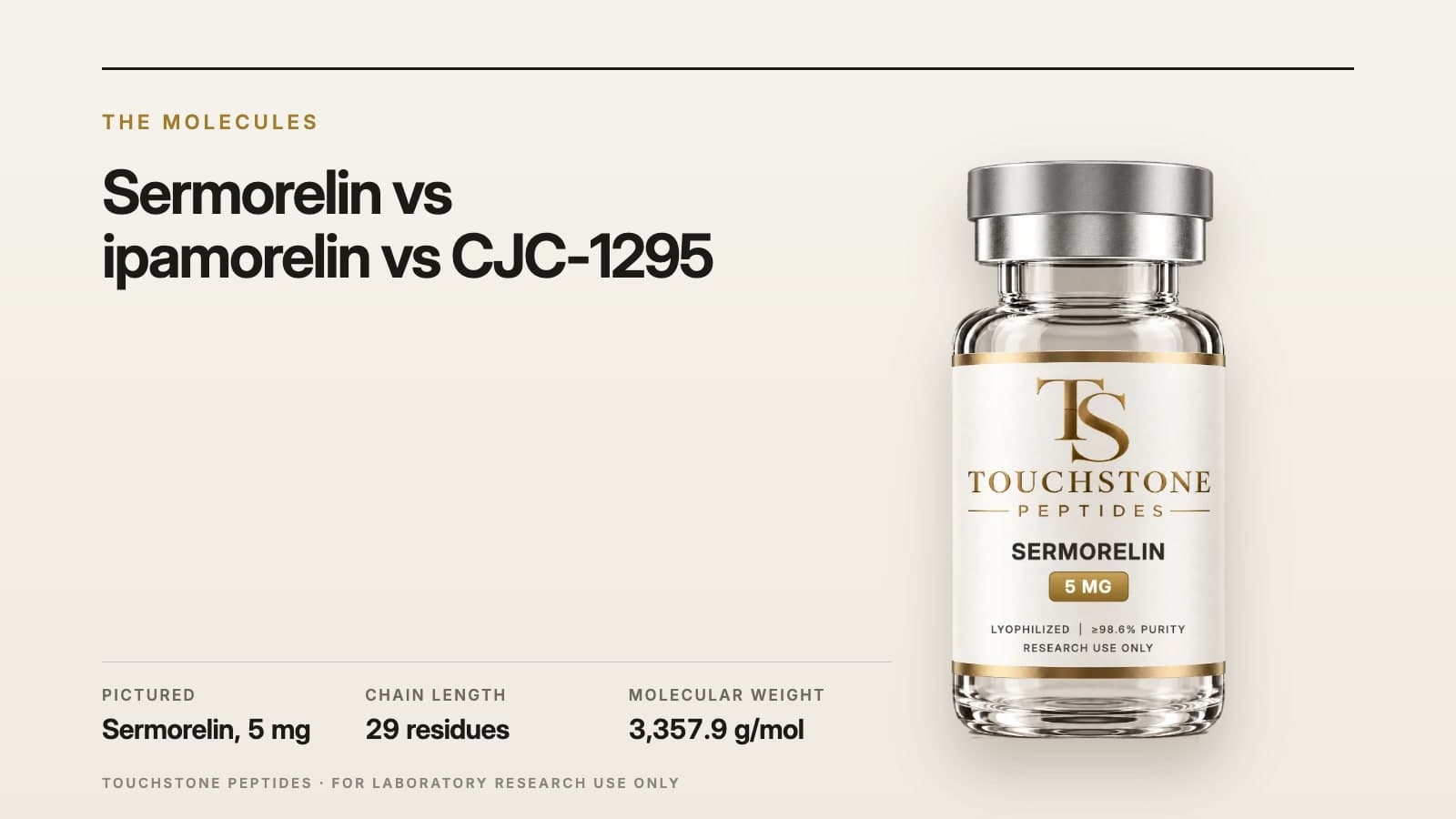
Sermorelin is the first 29 residues of human GHRH with a C-terminal amide, YADAIFTNSYRKVLGQLSARKLLQDIMSR-NH2. No substitutions, no lipid, no cap. PubChem CID 16132413 gives C149H246N44O42S and an average molecular weight of 3357.9; CAS 86168-78-7. The single methionine at position 27 is the residue most exposed to oxidation in this sequence.
Drugs@FDA lists Geref (sermorelin acetate), NDA 020443, EMD Serono, approved September 26, 1997, with marketing status "Discontinued" and a note that a Federal Register determination found the product "was not discontinued or withdrawn for safety or effectiveness reasons." Because sermorelin acetate is a component of an approved drug, it appears in FDA's 503B Category 1 list with the approved-component mark and is not on the 503A category lists. The catalog carries sermorelin, the 29-residue amide, as a lyophilized vial.
Ipamorelin: a pentapeptide with three unusual residues
Ipamorelin is Aib-His-D-2-Nal-D-Phe-Lys-NH2, five residues, three of which are not among the twenty coded amino acids in their usual form: Aib (2-aminoisobutyric acid, an alpha,alpha-disubstituted residue), D-2-naphthylalanine and D-phenylalanine. PubChem CID 9831659 gives C38H49N9O5 and 711.9; CAS 170851-70-4; Novo Nordisk code NNC 26-0161.
The 1998 paper that introduced it says it was "identified within a series of compounds lacking the central dipeptide Ala-Trp of growth hormone-releasing peptide (GHRP)-1", and that it acts "via a GHRP-like receptor", the receptor now called GHS-R. It was studied in primary rat pituitary cells, anaesthetised rats and conscious swine. Helsinn later ran two Phase 2 trials (NCT00672074 and NCT01280344, both completed) with no approval following.
FDA placed ipamorelin acetate in 503B Category 2 on September 29, 2023 and it is still there as of September 21, 2026; its 503A nomination was withdrawn. FDA's Category 2 entry cites a published clinical report of serious adverse events, including death, in a study of ipamorelin (bulk drug substances page, content current April 22, 2026).
We stock ipamorelin as a lyophilized vial.
CJC-1295: substituted GRF(1-29) with an albumin-binding handle
CJC-1295 is GRF(1-29) with four substitutions and a thirtieth residue, a lysine carrying a maleimide that bonds to serum albumin; the full identity, and the difference from the DAC-less "Mod GRF 1-29", is in CJC-1295 with DAC and without. Its only registered trial, a ConjuChem Phase 2 (NCT00267527), is terminated, and it was already outside 503A Category 2 by September 27, 2024; the April 22, 2026 page lists it as withdrawn. We stock CJC-1295 as a lyophilized vial.
The comparison table
| Sermorelin | Ipamorelin | CJC-1295 | |
|---|---|---|---|
| Class (literature) | GHRH analogue | GHS-R ligand | GHRH analogue |
| Residues | 29 | 5 | 30 |
| Modifications | C-amide | Aib, D-2-Nal, D-Phe, C-amide | D-Ala2, Gln8, Ala15, Leu27, Lys30(maleimidopropionyl), C-amide |
| Formula | C149H246N44O42S | C38H49N9O5 | C165H269N47O46 |
| Average MW | 3357.9 | 711.9 | 3647.2 |
| CAS | 86168-78-7 | 170851-70-4 | 446262-90-4 |
| PubChem CID | 16132413 | 9831659 | 91971820 |
| US approved product | Geref, NDA 020443, 1997, discontinued | none | none |
| 503A / 503B | 503B Category 1 (approved component) | 503B Category 2 (since Sept 29, 2023); 503A withdrawn | outside 503A Category 2 by Sept 27, 2024; no category |
| WADA 2026 | S2.2.4, named | S2.2.4, named (GHS) | S2.2.4, named |
Status lines are as of September 21, 2026.
Two statuses, one shelf
The two statuses are an approved product discontinued for reasons other than safety or effectiveness (sermorelin), and no approval at all (ipamorelin, CJC-1295). Regulatory status attaches to a product and a sponsor, not to a molecule in a research vial; a vial of sermorelin is not Geref. All three sit on the hormones shelf as research-use-only lyophilized vials.
Common questions
Is ipamorelin a GHRH analogue like sermorelin?
No. Ipamorelin is a five-residue synthetic peptide that the literature describes as acting at the growth hormone secretagogue receptor, the receptor whose natural ligand is ghrelin. It shares no sequence with GHRH. Sermorelin and CJC-1295 are both variations on the GHRH sequence and are described as binding the GHRH receptor.
Are sermorelin, ipamorelin and CJC-1295 FDA approved?
None has an approved product on the market as of September 21, 2026. Sermorelin was the active ingredient of Geref, approved in 1997 and since discontinued for reasons other than safety or effectiveness. Ipamorelin and CJC-1295 have never been approved in the United States.
What is the structural difference between sermorelin and CJC-1295?
Both start from the first 29 residues of human GHRH. Sermorelin is that sequence with a C-terminal amide and nothing else. CJC-1295 carries four substitutions (D-Ala2, Gln8, Ala15, Leu27) and a thirtieth residue, a lysine with a maleimidopropionyl group that bonds to serum albumin. Their average molecular weights are 3357.9 and 3647.2.
Are sermorelin, ipamorelin and CJC-1295 on the WADA Prohibited List?
Yes. WADA's 2026 list names all three in section S2.2.4: CJC-1295 and sermorelin as GHRH analogues, and ipamorelin among the growth hormone secretagogues. Both clauses are prohibited at all times.
Sources
- Sermorelin, CID 16132413, PubChem
- Ipamorelin, CID 9831659, PubChem
- CJC 1295, CID 91971820, PubChem
- Drugs@FDA: Geref, NDA 020443, FDA
- Raun K et al. Ipamorelin, the first selective growth hormone secretagogue. Eur J Endocrinol, 1998
- Kojima M et al. Ghrelin is a growth-hormone-releasing acylated peptide from stomach. Nature, 1999
- FDA, Certain bulk drug substances for use in compounding that may present significant safety risks, content current April 22, 2026
- WADA, The 2026 Prohibited List, valid 1 January 2026
For laboratory research use only. Not a drug, not a supplement, and nothing here is a claim about what any of this material does in a person or an animal.