
Are peptides controlled substances? The DEA schedules, HGH and the steroid line
No research peptide, BPC-157 included, is on the federal drug schedules. Why HGH sits under a separate statute, why steroids are Schedule III, and how WADA's list differs from DEA's.
No. As of October 21, 2026, none of the peptides sold for research, BPC-157 included, appears in the five federal schedules of the Controlled Substances Act, so none is a DEA-scheduled drug. The nearest exception people have in mind is human growth hormone: it is not scheduled either, but a separate provision of the Food, Drug, and Cosmetic Act, 21 U.S.C. 333(e), makes distributing it outside an authorized medical use a federal crime that DEA may investigate. The class that is scheduled is anabolic steroids, in Schedule III, and steroids are not peptides.
What makes a substance a controlled substance?
A controlled substance is defined by a list, not by chemistry or by reputation. The Act's definition, at 21 U.S.C. 802(6), is "a drug or other substance, or immediate precursor, included in schedule I, II, III, IV, or V." The schedules are set out in 21 U.S.C. 812(c) and kept current in 21 CFR Part 1308, sections 1308.11 to 1308.15.
A substance gets onto a schedule by rulemaking. Under 21 U.S.C. 811 the Attorney General, acting through DEA, must weigh eight factors, starting with "its actual or relative potential for abuse" and including "scientific evidence of its pharmacological effect" and "its psychic or physiological dependence liability." Each schedule then needs its own statutory findings. For Schedule III those are:
(A) The drug or other substance has a potential for abuse less than the drugs or other substances in schedules I and II. (B) The drug or other substance has a currently accepted medical use in treatment in the United States. (C) Abuse of the drug or other substance may lead to moderate or low physical dependence or high psychological dependence. 21 U.S.C. 812(b)(3)
So the question "is this peptide controlled?" has a mechanical answer: is it named in Part 1308, or does it fall within a class definition that Part 1308 schedules?
Are peptides on the DEA schedules?
No. We searched the full text of 21 CFR Part 1308 as published on eCFR (Title 21 current through October 19, 2026). The words "peptide" and "hormone" do not appear anywhere in it, and neither does any of the peptide names below. The same text names testosterone, fentanyl and ketamine, so the search was reading the schedules, not an empty page.
| Substance | In 21 CFR Part 1308? | What governs it federally instead | WADA 2026 section |
|---|---|---|---|
| BPC-157 | No | FD&C Act (unapproved new drug if intended for people) | S0 |
| TB-500 / thymosin beta-4 | No | As for BPC-157 | S2.3 |
| Sermorelin, tesamorelin, CJC-1295 | No | As for BPC-157 | S2.2.4 |
| Ipamorelin | No | As for BPC-157 | S2.2.4 |
| Semaglutide, tirzepatide, retatrutide | No | As for BPC-157 | Not named |
| Kisspeptin | No | As for BPC-157 | S2.2.1 |
| Human growth hormone (somatropin) | No | FD&C Act, plus the distribution offence in 21 U.S.C. 333(e) | S2.2.3 |
| Anabolic steroids | Yes, Schedule III, 21 CFR 1308.13(f) | Controlled Substances Act and FD&C Act | S1.1 |
The table is a statement about federal scheduling as of October 21, 2026. It is not a statement that any of these materials may be sold for use in a person; that question is answered by a different statute, covered below.
Is BPC-157 a controlled substance?
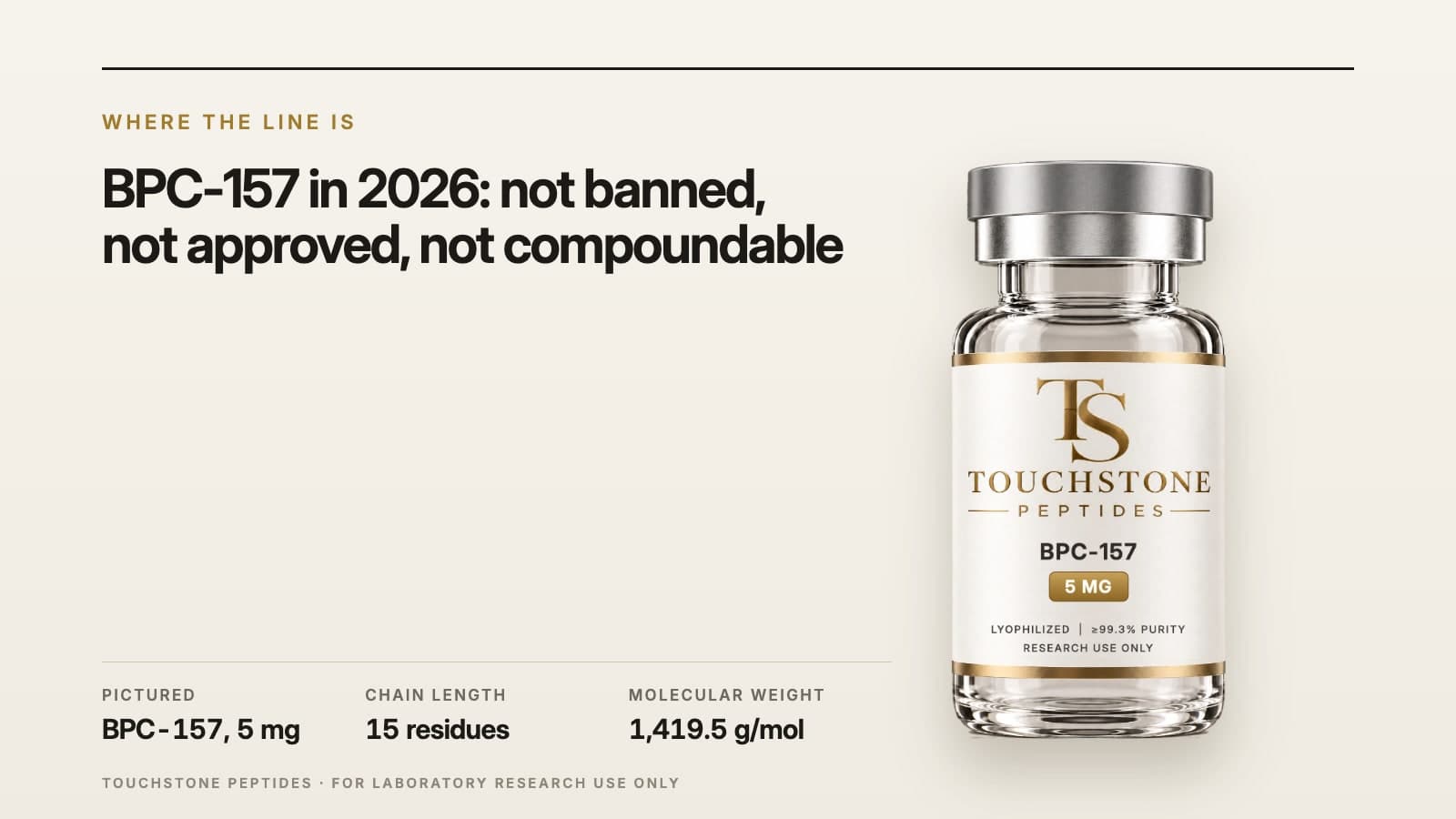
No. BPC-157, a fifteen-residue peptide we stock as a lyophilized vial, is not named in Part 1308 and does not meet the Schedule III anabolic-steroid definition, which is anchored to testosterone chemistry. Its federal status is set by the FD&C Act instead: it has no FDA-approved product, it is in no 503A category and not on the 503A bulks list, and FDA staff proposed in July 2026 that it not be added. Its dated record is in BPC-157 legal status in 2026.
In sport the answer is different. WADA's 2026 Prohibited List names BPC-157 in section S0, non-approved substances, prohibited at all times. That is an anti-doping rule, not a DEA schedule, and the difference is explained further down.
Is HGH a controlled substance?
Not in the scheduling sense. Human growth hormone is not listed in any of the five schedules in Part 1308. It is, however, the one hormone with its own criminal distribution offence, written into the Food, Drug, and Cosmetic Act rather than the Controlled Substances Act:
Except as provided in paragraph (2), whoever knowingly distributes, or possesses with intent to distribute, human growth hormone for any use in humans other than the treatment of a disease or other recognized medical condition, where such use has been authorized by the Secretary of Health and Human Services under section 355 of this title and pursuant to the order of a physician, is guilty of an offense punishable by not more than 5 years in prison, such fines as are authorized by title 18, or both. 21 U.S.C. 333(e)(1)
The rest of the subsection explains why people assume HGH is scheduled. Paragraph (2) raises the maximum to ten years where the offence involves someone under 18. Paragraph (3) counts a conviction as "a felony violation of the Controlled Substances Act" for forfeiture purposes. Paragraph (5) says "The Drug Enforcement Administration is authorized to investigate offenses punishable by this subsection." DEA involvement and CSA-style forfeiture, without a schedule listing, is the source of most of the confusion.
The definition is narrow. Paragraph (4) says the term "means somatrem, somatropin, or an analogue of either of them." It does not name growth hormone releasing hormone analogues such as sermorelin, a twenty-nine-residue GHRH analogue, or growth hormone secretagogues such as ipamorelin, a pentapeptide. Those are different molecules acting at different receptors, and none of them is scheduled. This catalog does not list somatropin.
The history is short. Subsection (e) was first added in 1988 by Pub. L. 100-690, when it covered anabolic steroids. In 1990, Pub. L. 101-647 rewrote it to cover human growth hormone; the same law brought anabolic steroids into the Controlled Substances Act. Steroids went onto a schedule and HGH was left with a penalty of its own, which is where the two have stayed.
Why are anabolic steroids Schedule III but peptides are not?
Because the scheduled class is defined by structure and pharmacology tied to testosterone. 21 CFR 1308.13(f) places in Schedule III "any substance meeting the definition of anabolic steroid," followed by a list of androstane and related ring compounds. The statutory definition reads:
The term "anabolic steroid" means any drug or hormonal substance, chemically and pharmacologically related to testosterone (other than estrogens, progestins, corticosteroids, and dehydroepiandrosterone) 21 U.S.C. 802(41)(A)
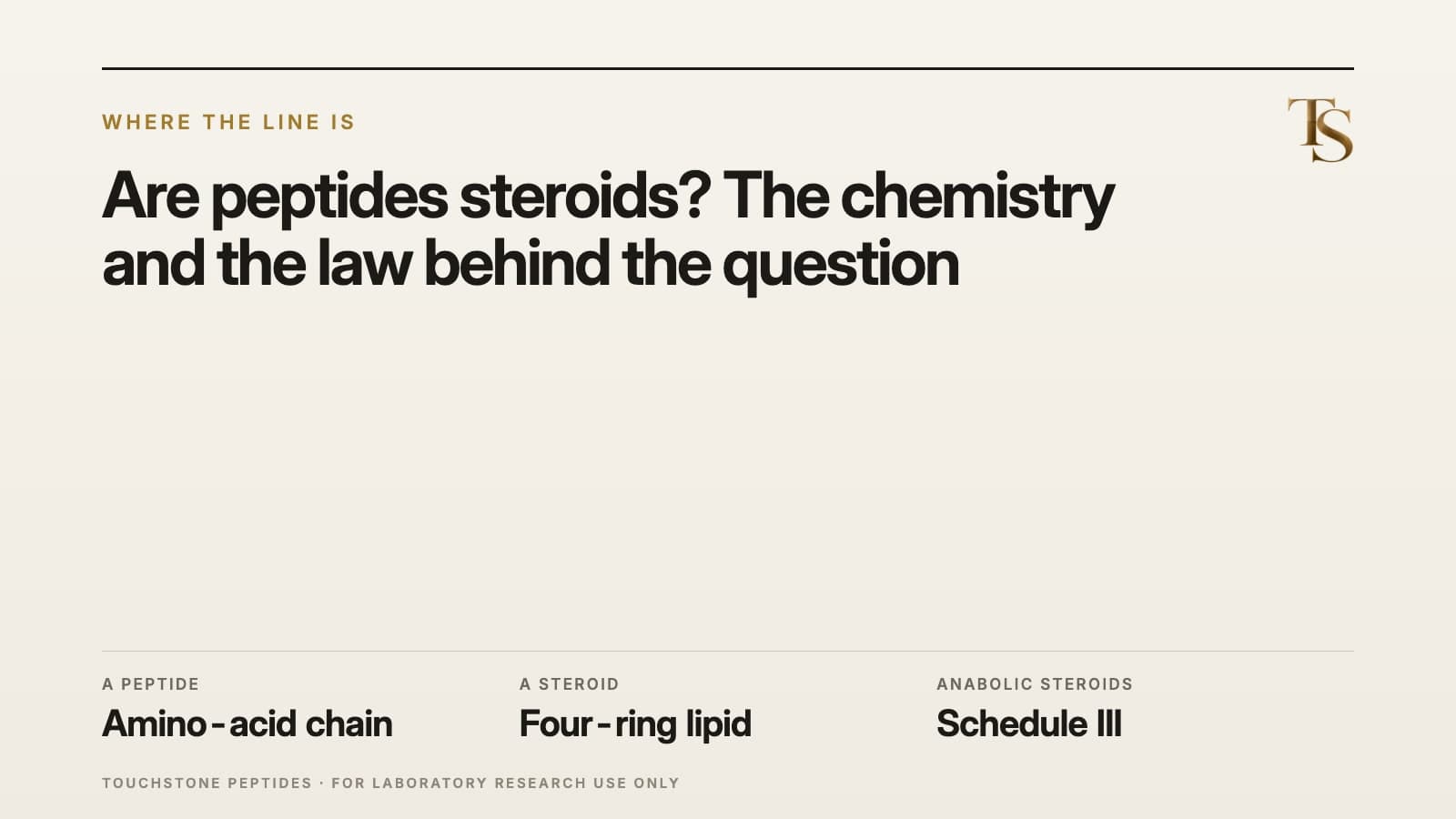
A peptide is a chain of amino acids joined by amide bonds; a steroid is a four-ring lipid. A peptide cannot be "chemically and pharmacologically related to testosterone" in that sense, which is why the steroid schedule does not reach it. The chemistry is set out side by side in are peptides steroids?.
Is the WADA prohibited list the same as DEA scheduling?
No. They answer different questions for different people.
| DEA schedules (Controlled Substances Act) | WADA Prohibited List | |
|---|---|---|
| Who issues it | US Department of Justice, through DEA rulemaking | World Anti-Doping Agency, a sports body |
| Who it binds | Everyone in the United States | Athletes and others under the World Anti-Doping Code |
| Legal force | Federal criminal law | Sport eligibility and sanctions only |
| How a substance is added | Statutory findings and the eight factors of 21 U.S.C. 811 | Annual list revision by WADA's Executive Committee |
| Peptides on it | None of the peptides in the table above | Many: S0 (BPC-157), S2 (GH, GHRH analogues, secretagogues, thymosin beta-4) |
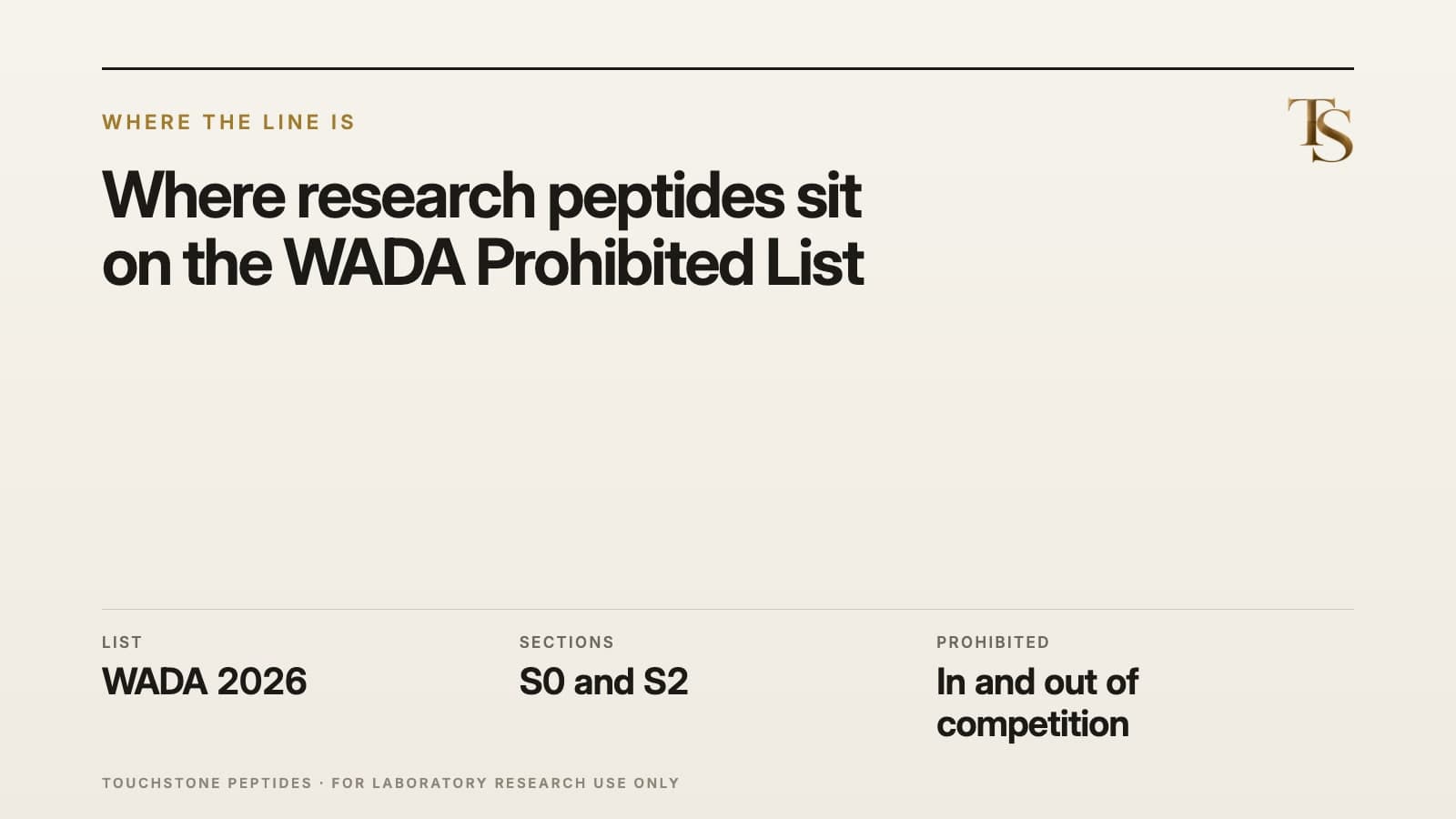
A peptide can be prohibited in sport and unscheduled in law at the same time, and most of the commonly searched ones are. WADA's 2026 List puts growth hormone, "its analogues and fragments" in S2.2.3, GHRH analogues including "CJC-1295, sermorelin and tesamorelin" in S2.2.4, and "Thymosin-ß4 and its derivatives e.g. TB-500" in S2.3. None of those placements changes US criminal status. The section-by-section map is in WADA S0, S2 and strict liability.
If a peptide is not scheduled, what governs it?
The Federal Food, Drug, and Cosmetic Act. Under 21 U.S.C. 321(g)(1) an article is a drug when it is "intended to affect the structure or any function of the body of man or other animals," among other limbs, and under 21 U.S.C. 355(a) a new drug cannot enter interstate commerce without an approved application. Intended use is judged under 21 CFR 201.128 by the seller's "objective intent," shown by "labeling claims, advertising matter, or oral or written statements" and "the circumstances surrounding the distribution of the article." That is why this site publishes no claims and no use guidance. The whole framework, dated, is in are peptides legal in the United States?.
State law is a separate layer. The Controlled Substances Act says, at 21 U.S.C. 903, that it does not "occupy the field" to the exclusion of state law, and states keep their own schedules. This piece covers federal law only.
Frequently asked questions
Are peptides scheduled drugs?
No, as of October 21, 2026. Neither the word "peptide" nor any commonly sold research peptide appears in 21 CFR Part 1308, the federal schedules. Peptides are regulated under the FD&C Act instead.
Is HGH a Schedule III drug?
No. Human growth hormone is not on any federal schedule. Its distribution outside an authorized medical use is a separate federal offence under 21 U.S.C. 333(e), carrying up to five years in prison, and DEA is authorized to investigate it.
Is hCG a controlled substance?
Not federally. Neither "chorionic gonadotropin" nor "gonadotropin" appears in 21 CFR Part 1308 as of October 21, 2026. State schedules can differ, and WADA lists chorionic gonadotrophin in S2.2.1.
Does a WADA ban make a peptide illegal?
No. The WADA Prohibited List governs eligibility in sport. It has no force as US criminal law, and a substance can be prohibited at all times in sport while being unscheduled federally.
Could a peptide be scheduled in the future?
Yes, in principle. DEA can add any substance to a schedule by rulemaking under 21 U.S.C. 811 after weighing the eight statutory factors and making the findings for that schedule. As of October 21, 2026, Part 1308 names no peptide.
Sources
- 21 CFR Part 1308, Schedules of Controlled Substances, eCFR, Title 21 current through October 19, 2026
- 21 U.S.C. 333, Penalties (subsection (e), human growth hormone), Cornell LII
- 21 U.S.C. 802, Definitions (paragraphs 6 and 41), Cornell LII
- 21 U.S.C. 811, Authority and criteria for classification of substances, Cornell LII
- 21 U.S.C. 812, Schedules of controlled substances, Cornell LII
- 21 U.S.C. 903, Application of state law, Cornell LII
- 21 CFR 1308.13, Schedule III, govinfo, 2024 edition
- 21 U.S.C. 321, Definitions (drug, new drug), Cornell LII
- 21 CFR 201.128, Meaning of "intended uses", govinfo, 2024 edition
- The 2026 Prohibited List, World Anti-Doping Agency, valid January 1, 2026
- Certain Bulk Drug Substances for Use in Compounding that May Present Significant Safety Risks, FDA, content current as of April 22, 2026
For laboratory research use only. Not a drug, not a supplement, and nothing here is a claim about what any of this material does in a person or an animal.