
Home Blog Reading the paperwork
Reading a chromatogram
One peak is the answer everyone wants. What the shoulders, the late cluster and the flat stretch before it are telling you.
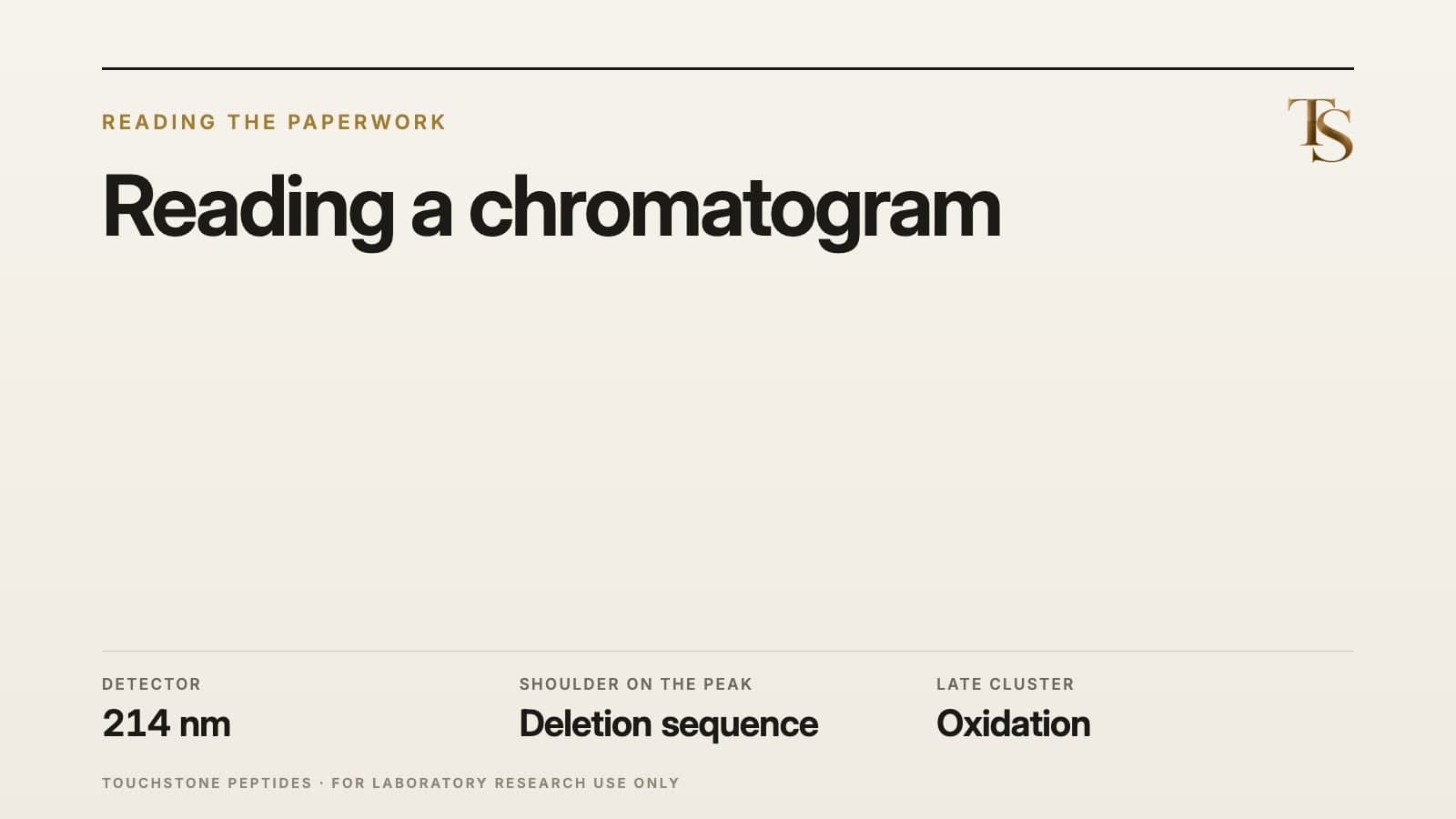
A purity figure is a chromatogram reduced to one number. The trace itself carries the part the number throws away: not how much of the material is impurity, but what kind.
What the detector is looking at
At 214 nm the detector is reading the peptide bond itself, which is why it sees peptides brilliantly and salt and water hardly at all. That is the same fact that makes purity and net peptide content different questions, and it is worth holding on to while reading the trace: everything you can see is peptide of some description.
Shoulders on the main peak
A bulge on the leading or trailing edge of the product peak is usually a deletion sequence — a chain missing one residue from somewhere in the middle. It is chemically almost identical to the product, so it comes off the column almost at the same time, and integration software will often fold it into the main peak rather than report it separately.
This is why the shape matters and the number alone does not. A clean symmetrical peak at 98.5% is better material than a shouldered one at 99.2%.
A cluster late in the run
Small peaks eluting after the product usually mean oxidation, most often at methionine or tryptophan. On a fresh lot they should be minimal. On an old one they are the first visible sign that storage has not been what it should be.
Peaks at the very front
Anything at or near the void volume came off without interacting with the column at all — salts, small polar fragments, the injection solvent. Usually uninteresting, occasionally the tell that a sample was dissolved in something it should not have been.
The flat part
A baseline that drifts or sits noisy across the run is a method problem rather than a material problem, and it makes every integration on that trace less trustworthy. A flat, quiet baseline is quietly the most reassuring thing on the page.
Common questions
What does a shoulder on the main peak of an HPLC trace mean?
It usually means a deletion sequence, a chain missing one residue from somewhere in the middle. It is chemically almost identical to the product, so it comes off the column at almost the same time, and integration software will often fold it into the main peak instead of reporting it separately.
What do small peaks after the main peak on a chromatogram indicate?
They usually indicate oxidation, most often at methionine or tryptophan. On a fresh lot they should be minimal. On an old lot they are the first visible sign that storage has not been what it should be.
Is a higher purity percentage always better material?
No. The shape of the peak matters and the number alone does not. A clean symmetrical peak at 98.5% is better material than a shouldered one at 99.2%, because a shoulder is usually a deletion sequence that integration software has folded into the main peak.
What does a noisy or drifting baseline on a chromatogram mean?
It is a method problem, not a material problem. A baseline that drifts or sits noisy across the run makes every integration on that trace less trustworthy, while a flat, quiet baseline is the most reassuring thing on the page.
For laboratory research use only. Not a drug, not a supplement, and nothing here is a claim about what any of this material does in a person or an animal.