
KPV (Lys-Pro-Val, alpha-MSH 11-13): structure, identity and US status
KPV is the tripeptide Lys-Pro-Val, residues 11 to 13 of alpha-MSH, catalogued as a free acid rather than the amide the hormone ends in. Its identifiers and masses, FDA's 2026 compounding review, the October 2026 HHS policy, and what a certificate should show.
KPV is the tripeptide L-lysyl-L-prolyl-L-valine, H-Lys-Pro-Val-OH: residues 11 to 13 of alpha-melanocyte-stimulating hormone (alpha-MSH). PubChem files it as CID 125672, formula C16H30N4O4, molecular weight 342.43, CAS 67727-97-3. No drug containing it is approved in the United States: Drugs@FDA lists no product with KPV as an active ingredient (checked November 7, 2026), and FDA's 2026 evaluation states that it is not a component of any FDA-approved drug. An HHS compounding policy of October 30, 2026 names KPV, but it is not an approval. The KPV sold here is research material, not an approved drug, and ours is sold for laboratory research use only.
Where the three residues come from
UniProt entry P01189, the 267-residue precursor pro-opiomelanocortin, maps alpha-MSH to residues 138 to 150, SYSMEHFRWGKPV, so KPV is residues 148 to 150. The same 13 residues open corticotropin (residues 138 to 176), which is why PubChem also lists KPV as "ACTH-(11-13)".
The end of the hormone differs from KPV in one group. UniProt annotates position 150 as "Valine amide", and Cody, Wilkes and Hruby (1984) give alpha-MSH as Ac-Ser-Tyr-Ser-Met-Glu-His-Phe-Arg-Trp-Gly-Lys-Pro-Val-NH2. KPV as catalogued is the free acid: PubChem's structure ends in COOH, one of its synonyms is "alpha-MSH (11-13) (free acid)", and HHS's policy writes H-Lys-Pro-Val-OH. The tripeptide was being studied on its own by 1984, when Richards and Lipton named it in Peptides as "alpha-MSH 11-13 (lysine-proline-valine)".
Identifiers and masses
| Field | KPV (free acid) | KPV acetate (1:1) |
|---|---|---|
| Formula | C16H30N4O4 | C16H30N4O4·C2H4O2 |
| Molecular weight | 342.43 | 402.49 |
| Monoisotopic mass of the peptide | 342.2267 | 342.2267 |
| CAS | 67727-97-3 | 2828433-34-5 |
| FDA UNII | 7V6LGD8S5R | HX2YJ5Z225 |
All three residues are L: PubChem's IUPAC name has three (2S) centres. We computed the monoisotopic mass from the formula as 342.2267, matching PubChem. The acetate's 402.49 is the formula weight in FDA's Global Substance Registration System (GSRS); FDA and HHS round it to 402.5. FDA's evaluation dated May 12, 2026 listed no UNII for either form and gave the acetate the free base's CAS number; GSRS now holds a separate record, UNII and CAS for each.
US status as of November 7, 2026
| Question | Answer |
|---|---|
| FDA-approved product | None |
| USP or NF monograph | None |
| 503A Category 2 | September 2023 to April 22, 2026; now "nominated but withdrawn" |
| FDA staff proposal, July 2026 | Do not add the free base or the acetate to the 503A bulks list |
| 503A bulks list (21 CFR 216.23) | Not listed |
| HHS policy, October 30, 2026 | Names KPV acetate; 503A compounding only, not an approval |
| WADA 2026 Prohibited List | Not named |
Wells Pharmacy Network nominated "KPV (lysine-proline-valine)" for the 503A bulks list. The nomination was withdrawn and FDA evaluated both forms "at its discretion". Its memo for the Pharmacy Compounding Advisory Committee's July 23-24, 2026 meeting concluded: "we propose not adding KPV (free base) or KPV acetate to the 503A Bulks List". FDA found neither form well characterized, in part because of "inconsistent naming conventions"; it notes that "KPV is a common name and not a United States Adopted Name (USAN)". HHS's policy records that "the PCAC voted in favor of inclusion"; FDA's meeting page links no vote record. FDA's Category 2 page, content current April 22, 2026, still says FDA has identified no human exposure data on drug products containing KPV by any route.
HHS's "Enforcement Discretion Policy Regarding 503A Compounding Using Certain Peptide Bulk Drug Substances" (notice at 91 FR 68526) lists KPV third of six peptides. Its Appendix B defines the covered substance as KPV acetate, C16H30N4O4·CH3COOH, 402.5. The policy concerns licensed 503A compounding only, under conditions that include an FDA-registered manufacturer and a certificate of analysis for each lot. It adds KPV to no list and approves nothing, and HHS says it is meant to "discourage the continued, widespread use of certain research-use-only peptides supplied by foreign manufacturers".
WADA's 2026 list does not name KPV, though its section S0 covers, unnamed, pharmacological substances that no government regulator has approved for human use. None of this concerns research material, which is sold for laboratory research use only and is not for human or veterinary use. Our status table and 503A categories explainer cover the other peptides.
What a KPV certificate should show
FDA says it "has encountered multiple salts, and derivatives, including different active moieties, sold commercially under the same common name", and it set aside literature on N-acetylated KPV as outside a KPV review. A mass spectrum tells them apart (our computation, proton 1.00728):
| Molecule | Formula | Monoisotopic | [M+H]+ |
|---|---|---|---|
| KPV, H-Lys-Pro-Val-OH | C16H30N4O4 | 342.2267 | 343.2340 |
| Amide, H-Lys-Pro-Val-NH2 | C16H31N5O3 | 341.2427 | 342.2500 |
| N-acetyl, Ac-Lys-Pro-Val-OH | C18H32N4O5 | 384.2373 | 385.2445 |
- Identity: m/z 343.23 with one proton or 172.12 with two. The salt does not change it; 402.5 quoted as an observed mass is the acetate's formula weight. See mass spectrometry and peptide identity.
- LC-MS/MS fragments (computed): y1 118.09, y2 215.14, b2 226.16.
- Purity by reversed-phase HPLC near 214 nm: with no tryptophan, tyrosine or phenylalanine, KPV barely absorbs at 280 nm.
- Diketopiperazine: FDA's evaluation records a report that KPV acetate forms Lys-Pro diketopiperazine as a major degradation product under forced acid, alkaline and peroxide conditions. Its [M+H]+ (C11H19N3O2, 226.155 by our computation) equals the b2 fragment, so it is identified by retention time, as a separate peak.
- Salt: a 1:1 acetate is 85% peptide by formula weight (342.43 / 402.49); see TFA salt or acetate salt.
What our certificates show
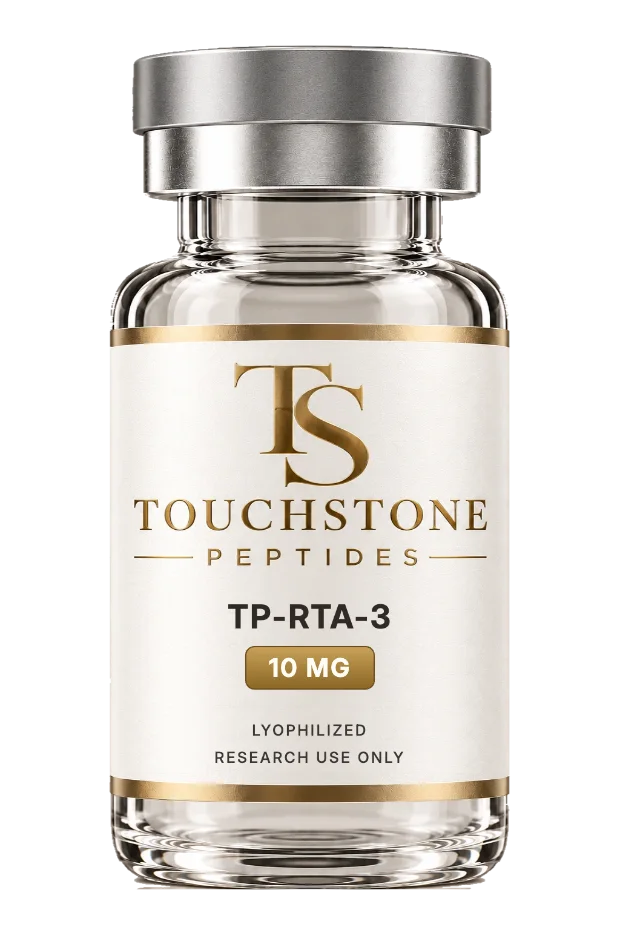
Our catalogue record gives KPV as C16H30N4O4, 342.43, CAS 67727-97-3, PubChem CID 125672, a lyophilized powder in a 10 mg size. Both certificates are from Bioviridian Inc., the testing laboratory, for lot KPV-10-0318:
| Certificate | Issued | Status | Purity (RP-HPLC, 214 nm) | Identity | Content |
|---|---|---|---|---|---|
| COA7614 | August 28, 2026 | Current | 99.73% | LC-MS/MS, conforms | 10.2 mg |
| COA3368 | April 3, 2026 | Archived | 99.9% | MALDI-MS, conforms | 9.86 mg |
COA7614 also reports endotoxin below 0.05 EU/ml, heavy metals below 0.01 ppm and sterility "Not Detected", and its number can be checked on the laboratory's site. KPV is 10 mg of the 80 mg KLOW blend, whose certificate COA7577 (lot KLOW-80-0713) reports a content for each of its four peptides, as a blend certificate should.
Common questions
Is KPV the same as alpha-MSH 11-13?
In sequence, yes. In the hormone the valine is amidated; KPV, PubChem CID 125672, is the free acid H-Lys-Pro-Val-OH.
Is KPV FDA approved?
No. Drugs@FDA lists no product containing it (checked November 7, 2026). HHS's October 2026 policy is enforcement discretion for compounding KPV acetate, not an approval.
Sources
- CID 125672, PubChem
- UniProt P01189, pro-opiomelanocortin (human)
- UNII 7V6LGD8S5R, FDA GSRS
- UNII HX2YJ5Z225, FDA GSRS
- Cody, Wilkes and Hruby, J Chromatogr, 1984
- Richards and Lipton, Peptides, 1984
- FDA briefing document, KPV-related bulk drug substances, July 2026
- PCAC meeting page, July 23-24, 2026, FDA
- FDA Category 2 page, content current April 22, 2026
- HHS notice, 91 FR 68526, October 30, 2026
- HHS policy with Appendices A and B (PDF)
- 21 CFR 216.23, eCFR, November 5, 2026
- openFDA drugsfda endpoint, November 7, 2026
- WADA 2026 Prohibited List (PDF)
For laboratory research use only. Not a drug, not a supplement, and nothing here is a claim about what any of this material does in a person or an animal.