


Handling
Storage, stability and the arithmetic of a stock solution.
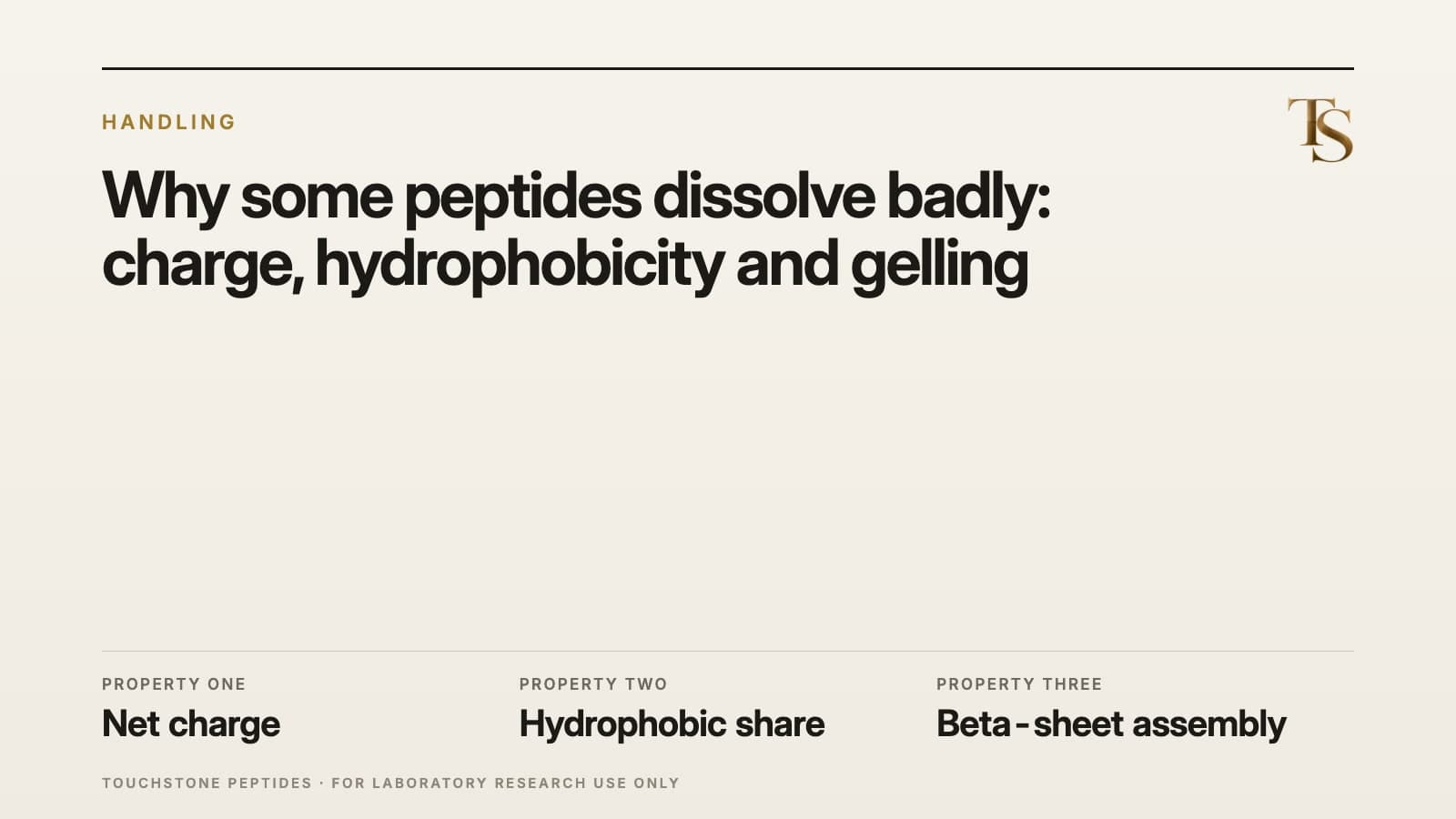 HandlingWhy some peptides dissolve badly: charge, hydrophobicity and gellingNet charge, isoelectric point, hydrophobic residue content and beta-sheet self-assembly decide whether a peptide dissolves clear, turns cloudy or gels. The chemistry, with worked examples from published sequences.
 HandlingWhere the 28 days number comes from (it is not peptide data)The 28-day figure often attached to peptides is a pharmacy standard for preserved multi-entry containers, tied to a 28-day microbiology test. It measures preservative effectiveness, not what happens to a peptide in solution.
 HandlingTFA salt or acetate salt: what the counter-ion changes about the vialWhere trifluoroacetate comes from, why it stays bound to basic residues, how much of a vial's mass it can be, what the literature reports about it in cell work, and what a certificate should say about salt form.
 HandlingDo lyophilized peptides survive heat in transit?Why a dry solid is more stable than a solution, what ICH-style testing at 25 °C and 40 °C has shown for lyophilized peptides, what changes first, and why a warm parcel is a different question for a powder than for a liquid.
 HandlingFreeze-thaw, aliquots and the residues that oxidizeWhich amino acids oxidize, deamidate or hydrolyse, what freezing and thawing do to a solution physically, what manufacturers' guides say about repeated freezing, and where those residues sit in the sequences we stock.
 HandlingMilligrams, micrograms and the units that are not weightsA factor of a thousand, a factor that is not a factor at all, and where the decimal point actually goes.
 HandlingWhat minus twenty is actually forCold slows three different degradation routes at three different rates, and one of them is not slowed by cold at all.
Other shelves
- Reading the paperworkWhat each line on a certificate measures, and what a weak one leaves out.16 pieces
- How it is madeSynthesis, freeze-drying, formulation and format: how a peptide becomes the vial, spray or strip on the shelf, and where the cost goes.4 pieces
- Where the line isWhat this site will and will not say about the material it sells, and why.13 pieces
- Sourcing and provenanceWhere research peptides come from, how to check a vendor with documents, and what an importer and a buyer are actually responsible for.5 pieces
- The moleculesWhat each peptide is: sequence, class, salt form, naming, and its regulatory status on a given date. Never what it does in a person.14 pieces
Nothing here is medical advice. Everything on this site is supplied for laboratory research use only.